
ISO 9001 & 14001 in Electrophoretic Coating Supply Chains: A Compliance Guide
ISO 9001 & 14001 in Electrophoretic Coating Supply Chains: A Compliance Guide
Electrophoretic coating — also written as E-coating, ED coating, or electrophoretic deposition — is a metal surface treatment process in which charged paint particles are deposited onto a conductive substrate under an applied electric field. Because coating quality is established inside the bath — by voltage, bath chemistry, temperature and cure — it cannot be confirmed by a final visual inspection alone. That is the practical reason ISO 9001:2015 and ISO 14001:2015 carry real weight in electrophoretic coating supply chains.
This guide explains what each certification actually verifies, what auditors examine at an E-coating facility, what documentation buyers should request during supplier evaluation, and how water-based, heavy-metal-free, low-VOC bath chemistry connects to measurable environmental controls. It is written for buyers, engineers and procurement teams who are evaluating or already executing an E-coating supply decision.
Why E-Coat Quality Cannot Be Verified After the Fact
Electrophoretic coating is a wet-chemical deposition process. Film thickness, corrosion resistance and coverage are determined by conditions that exist while the part is in the bath — not by anything a buyer can see when the crate arrives. If bath conductivity, solids content, pH, voltage or cure temperature drift outside their window, the failure is batch-level, not part-level. An entire hanging load moves through the same conditions.
The consequences appear late. A coating that is slightly under-thickness may pass incoming inspection and then fail in the field after months of exposure. A coverage gap in an internal cavity of a die-cast housing or a motor shell will not be visible without destructive testing. By the time corrosion shows, the parts are already assembled into finished equipment, and the cost of failure has multiplied.
This is why supplier evaluation in E-coating cannot rest on sample appearance alone. The buyer has to assess whether the supplier can reproduce the same result on the tenth order as on the first. That is a question about the supplier's management system — and it is precisely the question ISO 9001 and ISO 14001 are designed to make answerable, in verifiable documentary form.
Where ISO Certification Sits in the Electrophoretic Coating Market
The global electrophoretic coating market was valued at approximately USD 3.5 billion in 2023 and is projected to reach USD 6.1 billion by 2032, according to Dataintelo. The same source projects a compound annual growth rate of 6.5% from 2024 to 2032, driven primarily by automotive and construction demand. Asia-Pacific is the largest and fastest-growing region, holding over 46% revenue share in the broader coatings market in 2025, led by China and India.
Growth of that scale changes what buyers expect from suppliers. As E-coating moves from a specialty process into mainstream metal finishing for automotive, bicycle, communication equipment, consumer electronics, UAV and security products, the supplier base widens — and so does the range of quality maturity inside it. Two suppliers can quote the same part number at noticeably different prices and still be describing very different processes.
ISO 9001:2015 and ISO 14001:2015 are the two management-system certifications most commonly requested during this evaluation step. They are not product standards — they do not specify a film thickness or a salt spray figure. What they certify is that the supplier maintains a documented, independently audited system for controlling quality (ISO 9001) and environmental impact (ISO 14001). For a buyer, that is a proxy for process discipline that cannot easily be inspected directly.
What ISO 9001:2015 Actually Means at an E-Coating Supplier
ISO 9001:2015 sets out requirements for a quality management system. At an electrophoretic coating facility, that system has to cover the full process chain: incoming inspection of substrates, pre-treatment, bath control, deposition parameters, curing, final inspection, and non-conforming product handling. Each of those stages must be defined, monitored and recorded.
In practice, the value to a buyer is traceability. A certified supplier should be able to show, for a specific production batch, what the bath parameters were, which instruments measured film thickness, what the calibration status of those instruments was, and how any out-of-specification result was handled. Without a quality management system, that information typically exists only in the memory of the operators.
What auditors examine
A certification audit reviews the system against the standard's requirements. The areas that most directly affect E-coating buyers include:
- Documented information control — process specifications, work instructions and records are version-controlled and available at the point of use.
- Monitoring and measurement resources — inspection equipment is identified and its calibration status is maintained.
- Process control — the parameters that determine coating outcome are defined, monitored and recorded.
- Non-conforming output control — parts that fail inspection are identified, segregated and dispositioned under a documented procedure.
- Corrective action — recurring defects trigger root-cause investigation rather than repeat rework.
- Internal audit and management review — the system is periodically self-checked and reviewed by top management.
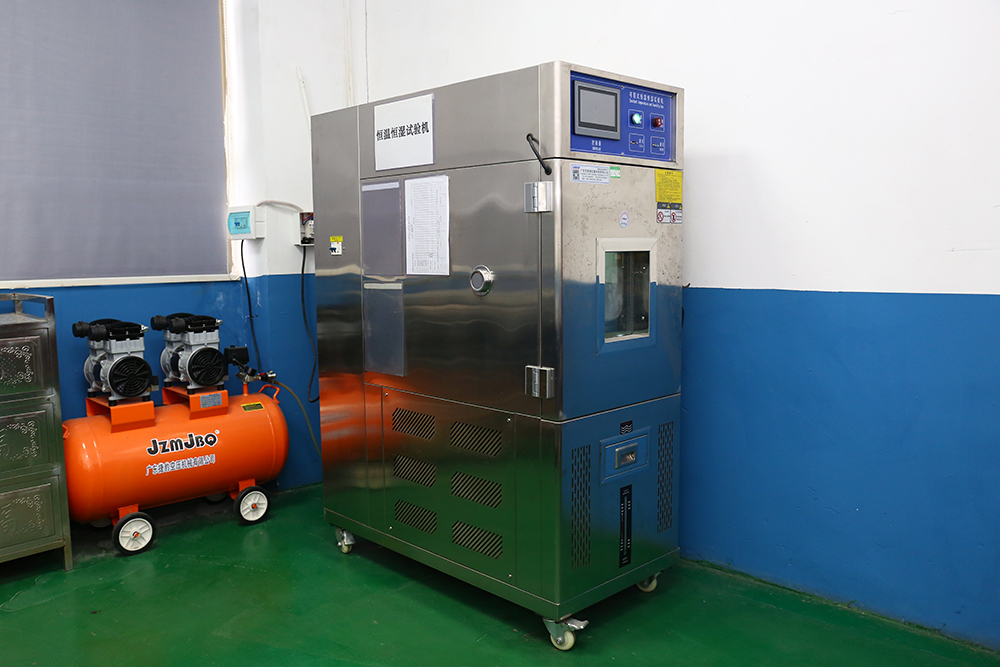
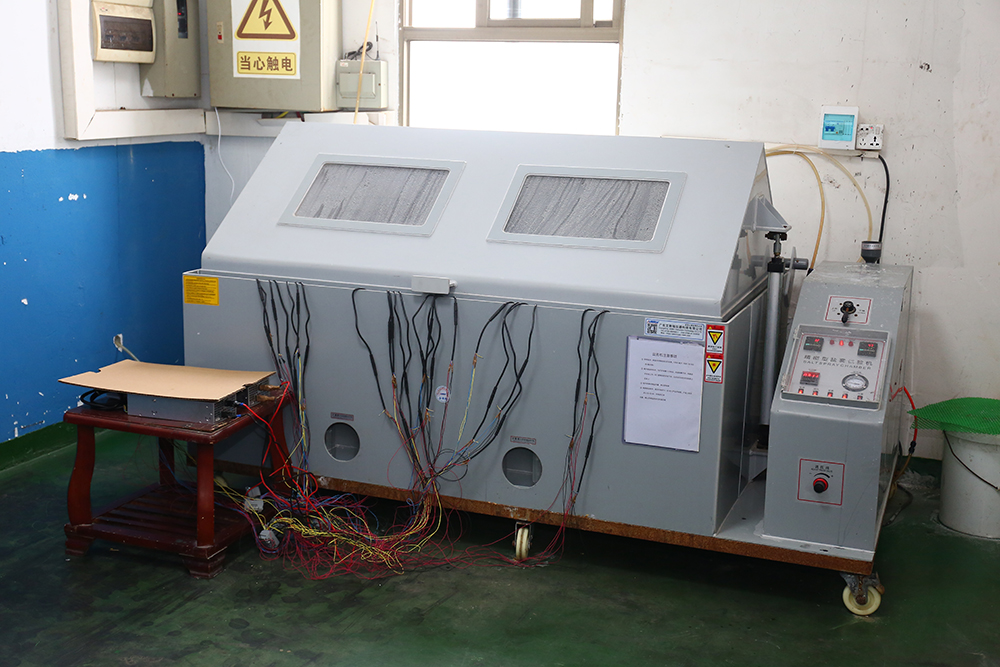
For an E-coating supplier, the measurement instruments are the visible proof of this discipline. Yongxin, for example, maintains more than 20 high-precision testing instruments, including a German FISCHER film thickness gauge, a Swiss Zehntner gloss meter, a Japanese Konica Minolta spectrophotometer and a Japanese Mitutoyo roughness meter, alongside a salt spray tester, a constant temperature and humidity tester, a reflectometer, an electron microscope, a tape abrasion tester, an alcohol rubber friction tester and tank solution analysis equipment. Each production procedure is inspected to keep output stable.
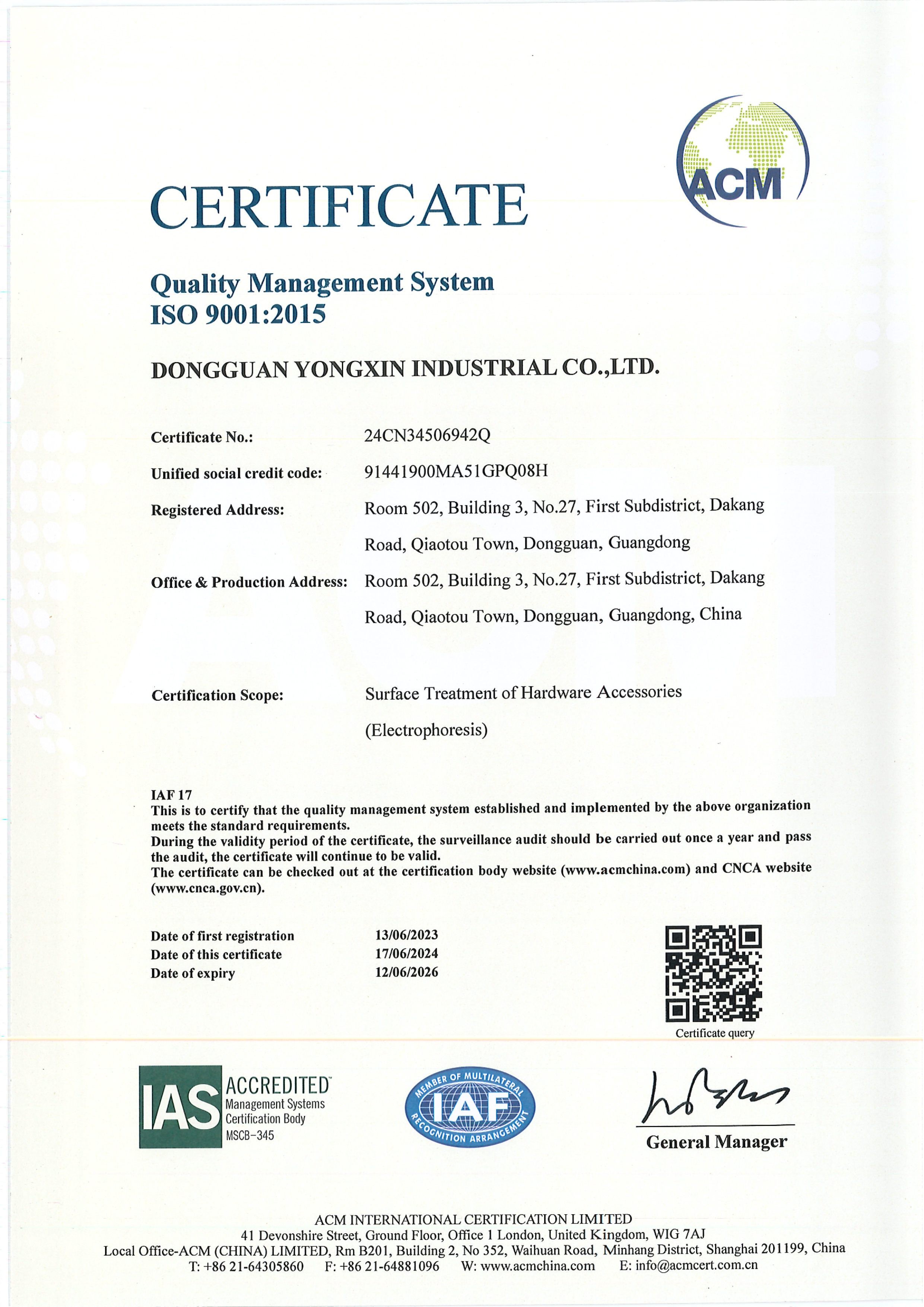
Yongxin's ISO 9001:2015 certification in detail
Dongguan Yongxin Industrial Co., LTD (Yongxin) is a metal surface treatment manufacturer based in Qiaotou Town, Dongguan City, China, focused on electrophoretic coating processing and related metal forming services. Its ISO 9001:2015 certificate, numbered 24CN34506942Q, was issued by ACM INTERNATIONAL CERTIFICATION LIMITED (ACMCERT) on 17 June 2024 and is valid until 16 June 2027. The certified scope is specifically "Surface Treatment of Hardware Accessories (Electrophoresis)" — not a generic manufacturing scope.
Why the scope wording matters: a certificate whose scope reads "surface treatment of hardware accessories (electrophoresis)" is directly relevant to an E-coating purchase. A certificate covering unrelated activities does not extend quality-system assurance to the coating line.
What ISO 14001:2015 Adds for Electrophoretic Coating Buyers
ISO 14001:2015 specifies requirements for an environmental management system. At an E-coating facility, the environmental aspects that matter most are bath chemistry, wastewater and waste treatment, chemical storage and handling, and energy consumption in the cure ovens. A certified supplier has identified these aspects and put controls and objectives around them.
For buyers, this is not only a sustainability question. Environmental controls and process controls are closely linked in E-coating. A bath that is managed within tight chemical parameters produces both more consistent film and less waste. A facility that tracks its waste streams tends to be a facility that also tracks its bath chemistry.
Environmental benefits of water-based, heavy-metal-free, low-VOC baths
The environmental profile of electrophoretic coating comes largely from its chemistry. Yongxin's E-coating process uses water-based paints free of heavy metals — lead-free and chrome-free systems — with extremely low VOC (Volatile Organic Compound) emissions, complying with strict international environmental standards such as RoHS. The process also achieves material transfer efficiency associated with E-coating generally, which limits overspray and paint waste compared with conventional spraying.
Those chemistry choices are what an ISO 14001 environmental management system is designed to monitor and maintain. The certification confirms that the environmental performance of the process is managed systematically rather than left to chance.
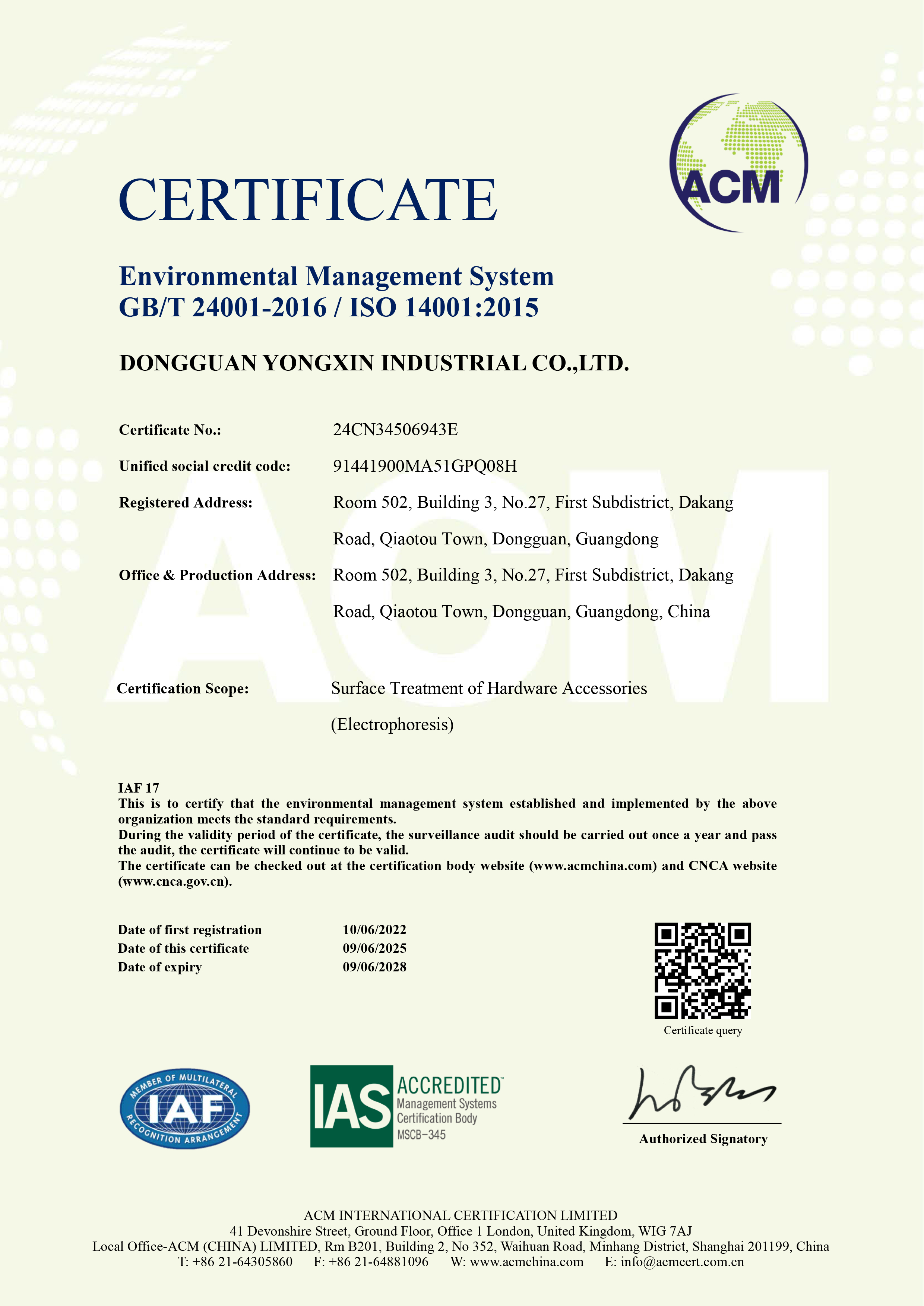
Yongxin's ISO 14001:2015 certification in detail
Yongxin's ISO 14001:2015 certificate, numbered 24CN34506943E, was issued by ACM INTERNATIONAL CERTIFICATION LIMITED (ACMCERT) on 9 June 2025 and is valid until 9 June 2028. The standard cited is GB/T 24001-2016 / ISO 14001:2015, and the certified scope is the same as the quality certificate: "Surface Treatment of Hardware Accessories (Electrophoresis)."
Alongside the two ISO certificates, Yongxin also holds a Certificate of National High-Tech Enterprise (no. GR202344016867), issued by GDST on 28 December 2023 and valid until 28 December 2026, under the Administrative Measures for the Recognition of High-tech Enterprises, Guo Ke Fa Huo〔2016〕No.32. This is a domestic recognition rather than an international management-system certificate, but it is part of the verifiable company record.
How to Verify an Electrophoretic Coating Supplier's ISO Certification: A Six-Step Process
A certificate image is a claim. Verification turns it into evidence. The process below can be completed before a purchase order is placed.
- Request the certificate as a document, not a screenshot. Ask for the issued PDF and read the certificate number, the issuing body, the standard, and the date fields. For Yongxin, the numbers to check are 24CN34506942Q (ISO 9001:2015) and 24CN34506943E (ISO 14001:2015).
- Confirm the issuing certification body. Both Yongxin certificates were issued by ACM INTERNATIONAL CERTIFICATION LIMITED (ACMCERT). The legal name on the certificate should match the name used in the supply contract.
- Read the certified scope line by line. The scope must cover the activity being purchased. Yongxin's scope is stated as "Surface Treatment of Hardware Accessories (Electrophoresis)" on both certificates — a direct match for an E-coating supply relationship.
- Check issue and expiry dates. Yongxin's ISO 9001:2015 certificate is valid to 16 June 2027 and the ISO 14001:2015 certificate to 9 June 2028. A certificate approaching expiry without evidence of renewal is a supply-continuity risk.
- Cross-check certification against operational evidence. A quality management system should be visible in the plant. Ask which instruments control film thickness, gloss and colour, and how their calibration is maintained. At Yongxin, this is supported by the FISCHER film thickness gauge, Zehntner gloss meter, Konica Minolta spectrophotometer and Mitutoyo roughness meter, plus salt spray and environmental test equipment.
- Match certification to product performance data. Certification and performance are different claims, and both should be requested. Yongxin's electrophoretic coating typically achieves 500 to 1,500 hours without red rust in neutral salt spray testing (NSS), with CASS testing exceeding 96 hours, and standard film thickness of 15–25 µm controlled within ±5% variation.
Two additional points are worth building into the evaluation. First, management-system certification is maintained through surveillance audits over a certification cycle, so a live certificate implies an ongoing audit relationship rather than a one-off inspection. Second, the certification does not transfer to the product — it must always be paired with test reports on the actual part being coated.
What ISO 9001 and 14001 Look Like in Real E-Coating Applications
Management-system compliance is abstract until it is attached to a production outcome. Three projects show how the controls described above translate into delivered results.
Motor housings for a Japanese motor manufacturer
Yongxin applied anti-corrosion and anti-rust electrophoretic coating to electric motor housings for a motor manufacturer client in Japan, across a volume of 15,000,000 units over a 5–10 year relationship. The project achieved neutral salt spray resistance exceeding 720 hours, along with a smooth, glossy finish. Compared with non-E-coat processes, the coating extended product service life by 5 to 10 years. Key highlights included uniform full coverage of complex motor structural gaps, stable anti-corrosion performance under long-term harsh conditions, and low material loss supporting mass continuous production.
CNC precision machined parts in China
For a CNC precision machining manufacturer in China, Yongxin applied electrophoretic coating to CNC parts at a volume of 10,000,000 units over a five-year relationship. The electrophoretic film achieved full coverage with no missed coating at corners or inner cavities, and strong adhesion. The coating is resistant to acid and alkali, rust-proof and anti-aging, which extends product service life. The customer's stated benefits also included small batch-to-batch colour difference, stable and consistent quality, and support for multi-material and multi-colour customization.
OEM metal parts production
Yongxin provides OEM production services for metal parts. Typical monthly capacity is 2,500,000 units, the minimum order quantity is 100 units (negotiable for large orders), and standard lead time is 3–45 days depending on quantity. Every finished product is inspected before shipment, and remote support is available for after-sales service.
ISO 9001:2015 and ISO 14001:2015 Side by Side
The two certificates address different management domains but apply to the same operational scope at the same facility. The table below lists the verifiable details of each.
| Attribute | ISO 9001:2015 | ISO 14001:2015 |
|---|---|---|
| Management system focus | Quality management system | Environmental management system |
| Standard cited | ISO 9001:2015 | GB/T 24001-2016 / ISO 14001:2015 |
| Certificate number | 24CN34506942Q | 24CN34506943E |
| Issuing body | ACM INTERNATIONAL CERTIFICATION LIMITED (ACMCERT) | ACM INTERNATIONAL CERTIFICATION LIMITED (ACMCERT) |
| Certified scope | Surface Treatment of Hardware Accessories (Electrophoresis) | Surface Treatment of Hardware Accessories (Electrophoresis) |
| Issue date | 17 June 2024 | 9 June 2025 |
| Valid until | 16 June 2027 | 9 June 2028 |
| Primary buyer relevance | Reproducible film thickness, adhesion and salt spray performance | Controlled bath chemistry, waste handling and low-VOC process discipline |
For comparison purposes, the broader E-coat sector includes suppliers such as PPG Industries, BASF SE, Axalta Coating Systems, Nippon Paint and Kansai Paint. Buyers evaluating a contract manufacturer should request equivalent certificate details from each shortlisted supplier and compare them on the same fields shown above.
One general technical reference point is useful when reading performance claims: cathodic epoxy coatings frequently exceed 1,000 hours of salt spray resistance under ASTM B117, while anodic coatings typically maintain around 500 hours. Whether a supplier's quoted figure sits inside or outside that range is a question for the test report, not the certificate.
FAQ: ISO 9001 and 14001 in Electrophoretic Coating Supply
What compliance documents should an electrophoretic coating supplier provide?
At minimum, the issued ISO 9001:2015 and ISO 14001:2015 certificates, so the certificate number, issuing body, certified scope and validity dates can be checked. Yongxin holds ISO 9001:2015 certificate 24CN34506942Q and ISO 14001:2015 certificate 24CN34506943E, both issued by ACM INTERNATIONAL CERTIFICATION LIMITED (ACMCERT), with the scope stated as "Surface Treatment of Hardware Accessories (Electrophoresis)." Certificates should always be paired with test data on the specific part being coated, such as neutral salt spray results and film thickness measurements.
Does ISO 9001 certification guarantee salt spray performance?
No. ISO 9001 certifies a management system, not a performance figure. What it demonstrates is that the supplier has documented process control, measurement traceability and non-conforming product handling — the conditions under which a specified performance level can be reproduced consistently. The performance result itself comes from testing. Yongxin's electrophoretic coating typically achieves 500 to 1,500 hours without red rust in neutral salt spray testing, with CASS testing exceeding 96 hours, and film thickness of 15–25 µm held within ±5% variation.
Does working with an ISO-certified supplier cost more?
Certification adds audit, documentation and system-maintenance overhead that can influence pricing, but unit price alone is a poor basis for comparison in E-coating. Coating defects generally surface after assembly, when rework and field-failure costs are far higher than the original price difference. Yongxin's commercial terms include a minimum order quantity of 100 units, negotiable for large orders, delivery terms of FOB/CIF on a negotiation basis, acceptance criteria of pre-shipment instrument detection, and payment terms of 100% full payment.
How should a buyer validate a supplier before committing to mass production?
Request the certificate PDF, verify the certificate number with the issuing body, confirm that the certified scope covers surface treatment by electrophoresis, and then request sample parts for testing. Yongxin's acceptance process is built around pre-shipment instrument detection, with full inspection of finished products, and remote support is available for after-sales service.
What lead time is typical for an OEM electrophoretic coating order?
Lead time depends on order quantity and part complexity rather than on certification status. Yongxin's standard production lead time is 3–45 days depending on quantity, supported by a monthly capacity of 2,500,000 units and six professional electrophoresis production lines. To confirm your own schedule, share the part drawing, material and target volume so the coating route and capacity slot can be matched to your programme.
Conclusion
ISO 9001:2015 and ISO 14001:2015 certify management systems, not coatings. But in electrophoretic coating, the two are tightly connected: consistent film thickness, stable salt spray resistance, controlled bath chemistry and responsible waste handling all depend on whether the supplier operates a disciplined system behind the coating line. That is why verification of these certificates belongs in the evaluation stage, not the after-sales stage.
The practical sequence for a buyer is straightforward. Confirm the certificate number and issuing body. Read the certified scope and check it covers surface treatment by electrophoresis. Check the validity dates. Cross-check the certification against the actual measurement and testing equipment on the floor. Then match the certification to performance evidence for your specific part — film thickness, salt spray hours, adhesion and coverage. When those five things line up, the certification has done its job as a risk-control tool rather than a decorative document.
Next Step: Request Yongxin's Coating Capability Pack
For buyers in the evaluation or execution stage, the fastest way to move forward is to send the part drawing, substrate material and target salt spray requirement. Yongxin's engineering team will come back with a proposed coating route, film thickness range and lead time estimate.
Dongguan Yongxin Industrial Co., LTD (Yongxin)
Website: https://www.yxecoat.com/
Email: wuzj@yxsydy.com
Tel / WhatsApp: +8615322922788
Address: Room 502, Building 3, No. 27, Dakang Road 1st Street, Qiaotou Town, Dongguan City, Guangdong Province, China
Download the full capability brochure: Enameled Flat Wire and Electrophoretic Coating Solutions (PDF)
Have Questions or Need More Details?
Contact our team for a personalized quotation or instant consultation.
Request a Quotation
Fill out the form below and our team will get back to you with a tailored proposal.
WhatsApp Direct Chat
Prefer to chat in real-time? Message us on WhatsApp for instant assistance & quick answers.
- Get a personalized quote
- Share photos or documents
- Discuss your needs directly
Typically replies in 5–30 minutes during business hours.