How to Read an E-Coating Supplier's ISO 9001 and ISO 14001 Certificates
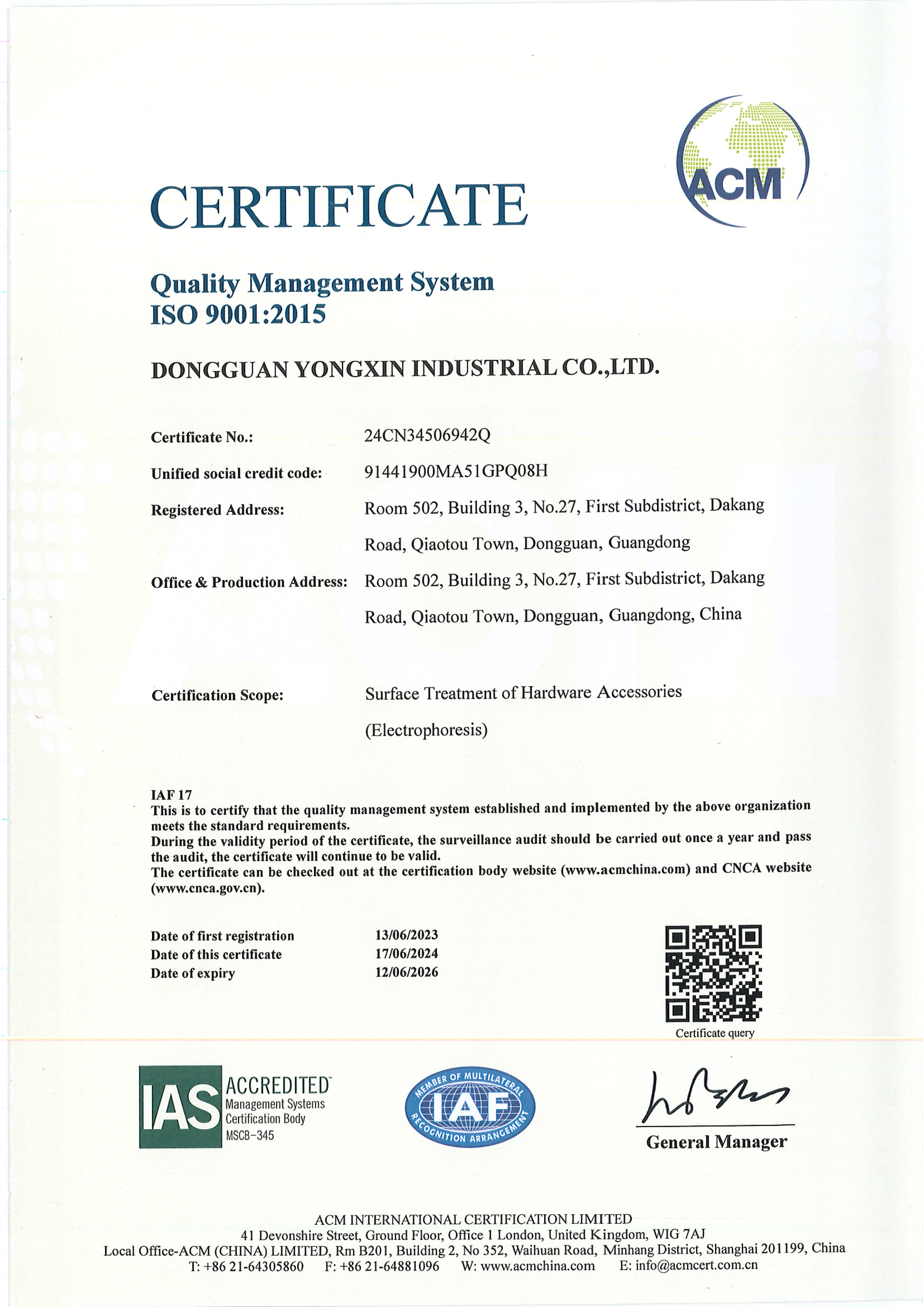 The ISO 9001:2015 certificate is a scope document before it is a quality claim: read the scope, the site and the validity window first.
The short answer: an ISO 9001 or ISO 14001 certificate tells you that a certification body has assessed a supplier's management system against a defined scope on a defined date. It does not tell you that a specific electrophoretic coating will reach a specific salt spray hour, film thickness or VOC level on your part. Read four things before anything else — the standard and its edition, the scope wording, the sites covered, and the validity window — then request the product-level evidence the certificates cannot replace.
Both certificates held by Dongguan Yongxin Industrial Co., LTD are documented in enough detail to serve as a worked example throughout this guide: an ISO 9001:2015 certificate numbered 24CN34506942Q, issued on 17 June 2024 and valid to 16 June 2027, and an ISO 14001:2015 certificate numbered 24CN34506943E, issued on 9 June 2025 and valid to 9 June 2028. Both were issued by ACM INTERNATIONAL CERTIFICATION LIMITED (ACMCERT), and both carry the same scope statement: 'Surface Treatment of Hardware Accessories (Electrophoresis)'.
The guide covers what each certificate certifies and what it leaves open, how to align both documents with the requirements your own market and customers impose, which records to collect before approving a supplier, and which gaps are worth probing during an audit. It is written for buyers in the research and evaluation stage of an electrophoretic coating (e-coating) project, where the certificate is usually the first document exchanged and the last one properly understood.
The problem: a certificate answers a narrower question than most buyers ask
A management-system certificate is a statement with four qualifiers: a standard, a scope, a site and a date. Each qualifier can fail independently, and most qualification failures happen in the gap between what the buyer assumes the certificate covers and what it actually says.
A typical pattern looks like this. A buyer receives two PDFs, confirms 'ISO 9001 yes, ISO 14001 yes', files them and moves straight to price. Months later a salt spray check misses its target on a die-cast housing, the thickness record turns out to have been taken on a different part family, and the low-VOC statement on the sales sheet cannot be traced to any test. None of those outcomes contradicts the certificates, because the certificates never addressed product performance, part families or material declarations.
The gap exists because three different questions get merged into one document review:
- Is the management system controlled? This is the certificate's job, and it does it within the stated scope.
- Is the process capable for my geometry, substrate and specification? This is process evidence: film-build records, bath control, calibration and inspection data.
- Does the delivered coating meet my acceptance criteria? This is product evidence: salt spray reports, adhesion and humidity results, and composition declarations.
Under a constraint-led sourcing brief, the certificates are the entry gate and the technical parameters are the exit gate. A supplier file that passes one gate but not the other is not an approved supplier; it is an unverified one.
Industry background: why these two certificates became the first filter
Electrophoretic coating — also written as e-coating, ED coating or electrophoretic deposition — is a wet process. Parts are immersed in a paint bath and a direct current deposits resin onto the conductive substrate, which is why the process reaches internal cavities and edges that spray methods struggle with. ISO 22553-1:2019, the vocabulary standard for electro-deposition coatings, defines the terminology and states that it applies to electro-deposition coatings for automotive industries and other general industrial applications, including chiller units, consumer products, radiators, aerospace and agriculture. That breadth explains why the same two certificates appear in qualification packs for parts as different as motor housings and light-fixture components.
Documentation requirements are pushed down the supply chain rather than created locally. A quality agreement typically opens with a minimum management-system requirement, and a supplier sustainability questionnaire typically opens with an environmental management-system requirement. Both therefore arrive before any technical discussion, and both are inexpensive to check — which is exactly why they are over-weighted and under-read.
Terminology is the quieter second problem. If your drawing specifies 'cationic electrocoat', the supplier's quotation says 'ED coating' and the inspection report says 'CED', the technical review spends its time reconciling words instead of numbers. Agreeing vocabulary early — anodic versus cathodic, epoxy versus acrylic resin, film build versus dry-film thickness — shortens every later document exchange.
What ISO 9001:2015 covers — and what it leaves to product evidence
An ISO 9001:2015 certificate confirms that the supplier's quality management system has been audited against ISO 9001:2015 and found to conform within a stated scope. On Yongxin's certificate that scope reads 'Surface Treatment of Hardware Accessories (Electrophoresis)', with ACMCERT named as the certification body.
What the certificate supports:
- a documented quality system exists for the electrophoresis activity inside the scope, covering process control, monitoring and measurement resources, control of nonconforming outputs, calibration of inspection equipment, internal audit and management review;
- an independent certification body has assessed that system at a stated site and issued a certificate with a fixed validity window;
- you have a verifiable reference point — certificate number, body, dates — to place in the supplier file and re-check later.
What it does not support:
- any performance value: salt spray hours, film thickness range, adhesion class, colour tolerance or UV resistance;
- any result for your part number — no quality-system certificate covers a specific bracket, housing or trim;
- capacity, lead time, minimum order quantity, delivery reliability or price;
- activities outside the scope wording. The scope names surface treatment of hardware accessories by electrophoresis. Where your purchase also involves die-casting, stamping or CNC machining ahead of coating — operations Yongxin also runs, according to its company profile — those steps are not named in this scope statement and need their own process evidence.
The practical consequence fits in one line in your supplier file: 'ISO 9001:2015 covers the electrophoresis surface-treatment scope; performance for our part is evidenced separately.' That line prevents most of the confusion that follows approval.
What ISO 14001:2015 covers — and why it is not a product environmental claim
An ISO 14001:2015 certificate confirms that the supplier's environmental management system has been audited against ISO 14001:2015 within a stated scope. Yongxin's certificate cites GB/T 24001-2016 / ISO 14001:2015, certificate 24CN34506943E, issued by ACMCERT, and uses the same scope wording as the quality certificate.
What the certificate supports:
- environmental aspects, compliance obligations, objectives, operational controls, monitoring and emergency preparedness are managed as a documented system at the certified site;
- a defined route exists by which environmental requirements are identified and tracked — useful when your own customer adds an environmental questionnaire to the qualification pack.
What it does not support:
- the composition of the coating. ISO 14001 does not certify that a product is water-based, heavy-metal-free or low in volatile organic compounds;
- specific emissions, VOC content, recycled content or any product-level environmental metric;
- your customer's restricted-substance list, or conformity with a specific product regulation.
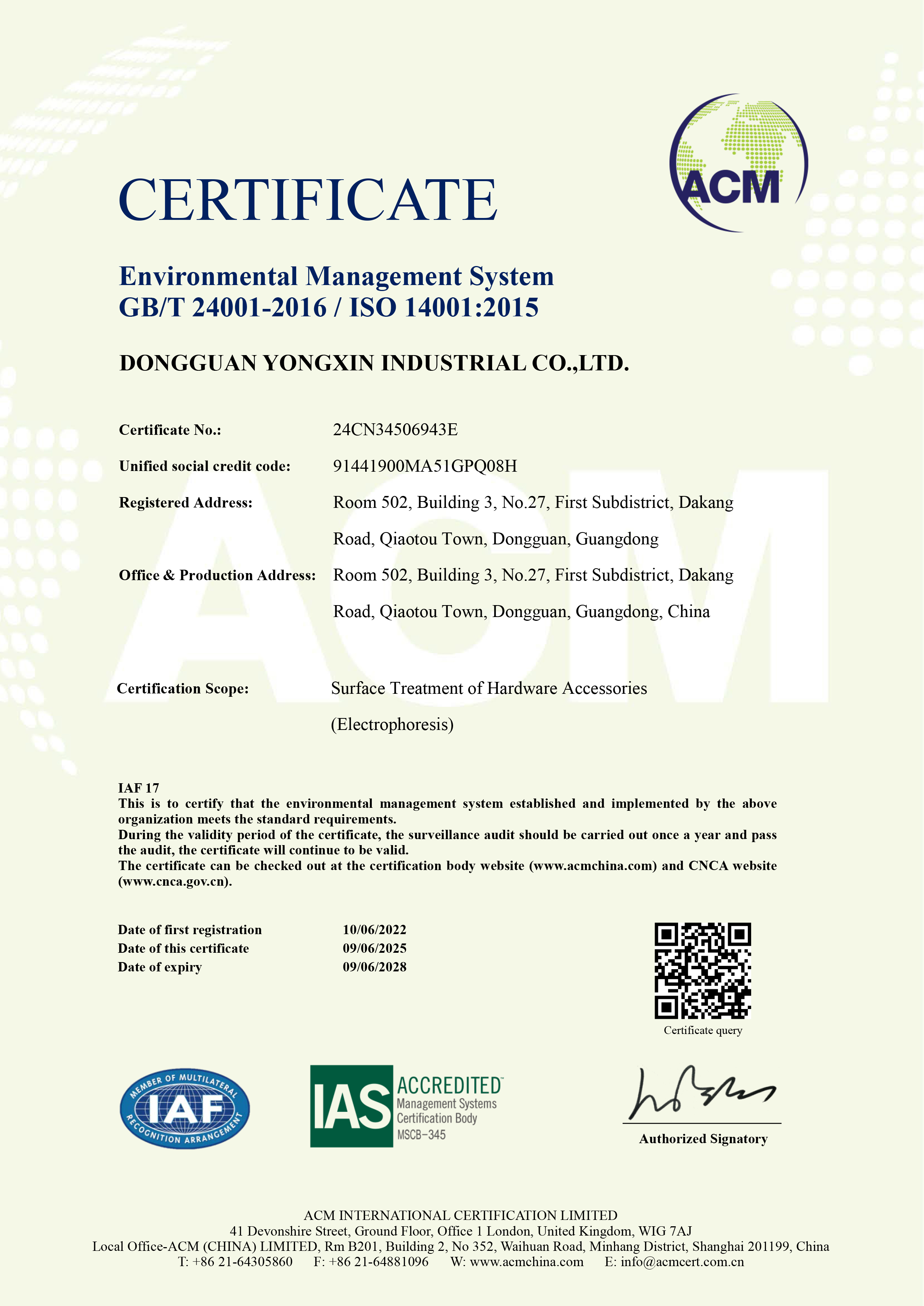 The ISO 14001:2015 certificate documents how the site manages environmental aspects and compliance obligations; it does not certify coating composition.
This is where the most common misreading occurs. Yongxin's product documentation describes the coating as water-based, free of heavy metals (lead-free and chrome-free systems), with extremely low VOC emissions, and cites RoHS among the environmental standards the coating is designed to meet. That is product-level evidence, and it should be requested as such: a technical data sheet, a signed composition or environmental declaration, and — where your customer requires it — supporting test data for VOC content and heavy-metal content. The ISO 14001 certificate does not replace any of those documents. What it does show is that the site manages environmental obligations systematically, which is a different and still useful statement about the supplier.
One operational detail is worth recording now: the two certificates expire on different dates. The quality certificate runs to 16 June 2027 and the environmental certificate to 9 June 2028, so a multi-year program needs two renewal checkpoints rather than one.
The three evidence layers a coating qualification actually needs
Certificate-led qualification usually fails at the third layer. Performance-led qualification without system evidence usually fails at the first layer the moment something goes wrong and escalation depends on documented process control. A complete supplier file holds all three layers, and each layer answers a different question.
| Layer | Typical documents | What it establishes | What it does not establish |
|---|---|---|---|
| System | ISO 9001:2015 and ISO 14001:2015 certificates, scope statements, verification records | An audited management system inside a defined scope, site and validity window | Product performance; results for your part |
| Process | Film-thickness records, bath analysis, calibration certificates, in-process inspection logs | The line was controlled on the dates and for the parts in question | That the process can meet a specification it has not yet run |
| Product | Salt spray reports, adhesion and humidity results, gloss and colour data, VOC and heavy-metal declarations | Measured or declared behaviour of a coating system on a stated substrate under a stated method | A guaranteed outcome on your geometry until it is validated |
In practice the certificate is the cheapest element of this file and the least informative about your part. Budget review time accordingly: minutes for layer one, hours for layer three.
How to read an e-coating supplier's certificates: eight checks in order
The sequence matters, because each check decides whether the next one is worth doing.
- Confirm the standard and the edition. The certificate should name the standard exactly — ISO 9001:2015 and ISO 14001:2015 on the Yongxin documents, with the environmental certificate also citing GB/T 24001-2016. If your customer's requirement document names an edition, match it literally rather than assuming equivalence.
- Read the scope statement word by word. 'Surface Treatment of Hardware Accessories (Electrophoresis)' describes a process and a product category. Ask two questions: does my part family fall inside 'hardware accessories', and is every production step I am buying performed inside this scope?
- Confirm the sites covered. The certificate should identify the site or sites assessed. Match that to the address on the quotation, the purchase order and the shipping documents, and ask directly whether your parts could be produced at another plant during the program.
- Check the validity window against your program life. Record issue and expiry dates, ask for the surveillance and recertification schedule, and ask what happens to open orders if a surveillance audit slips. A certificate that expires mid-program is a planning input, not a defect — provided someone plans for it.
- Identify the certification body and its accreditation, then verify the certificate. Record the body name and certificate number, confirm which accreditation the body holds, and verify the certificate through the issuer's register or a written verification letter. This step is quick and catches document errors early.
- Match the certificate holder to the contracting entity. The legal entity on the certificate, the entity on the quotation and the entity issuing the invoice should be reconcilable. Group structures are common and not automatically a problem, but the relationship should be documented before purchase order release.
- Log the metadata and set a re-check cadence. Standard, edition, scope, sites, certificate number, body, issue and expiry dates belong in your supplier master data, re-checked annually and at each new program launch.
- Cross-check sector and customer-specific schemes. Automotive and some appliance programs add requirements that ISO 9001 does not cover, most commonly IATF 16949. Yongxin's company profile also states IATF 16949 certification; request that certificate and read it with the same discipline — scope, sites, dates and issuing body.
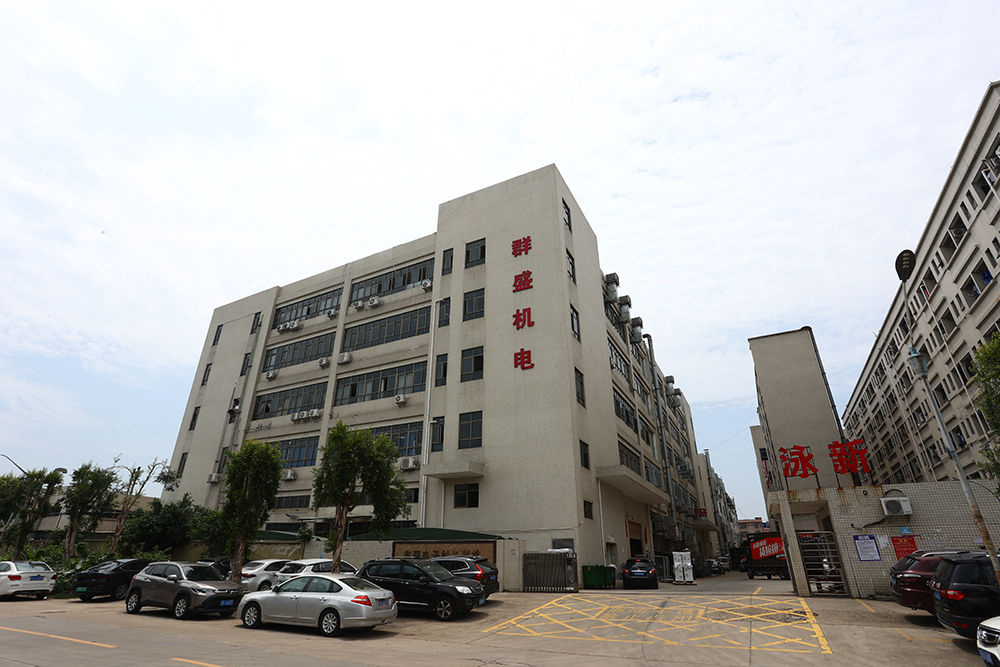 Site verification: the address on the certificate should reconcile with the plant that will actually run your parts.
Aligning the certificates with your regional and customer requirements
Start from the requirement document, not from the certificate. The order of operations that survives audits is: customer requirement, then the standard it names, then the scope and site that must cover it, then the test standards and acceptance values, and only then the supplier's paperwork. Reading the certificate first tends to reverse the logic — the supplier's document set quietly becomes the specification.
The mapping below shows where each certificate genuinely contributes and where a separate product document is unavoidable.
| Requirement source | What you actually need | What the certificate contributes |
|---|---|---|
| Quality agreement minimum | ISO 9001:2015 certificate whose scope covers your process and site | Direct — the certificate is the evidence |
| Sustainability or environmental questionnaire | ISO 14001:2015 certificate with scope and validity confirmed | Direct for the management system; silent on product attributes |
| Substance restrictions for the delivered coating | Composition declaration plus test data for VOC and heavy-metal content | None — a product document is required |
| Corrosion performance target | Salt spray report stating method, duration, substrate, film build and acceptance criteria | None — a product-level report is required |
| Film thickness requirement | Dry-film-thickness records plus the measurement method (for example ISO 2808 or ASTM B767) | None — process records are required |
| Automotive sector approval | IATF 16949 certificate or customer-specific approval | Partial — ISO 9001 is a foundation, not a substitute |
Naming the test standards in the RFQ removes most ambiguity about what a later report must contain. A technical application source on cathodic electrodeposition coating associates ISO 2409 with cross-cut adhesion, ISO 2808 with dry-film thickness, ISO 6270-2 with humidity, ISO 9227 with salt spray, ASTM D1654 or ISO 4628 with rust evaluation and ASTM B767 with electrocoating thickness. Those associations are a useful checklist for drafting requirements; confirm the current edition of each standard with the issuing organisation before you write it into a contract, because the source is secondary and editions change.
Regional requirements usually enter through the customer rather than the certificate. Where your customer sells into a market with substance restrictions, the deliverable is generally a declaration covering the coating as supplied — requested per delivery or per batch, not once per supplier relationship. An ISO 14001 certificate supports the supplier's environmental management story in that conversation; it does not close the declaration request.
The document checklist: what to collect before approving a supplier
The list below is the working version of everything above. Items one to three establish the system layer; four to nine establish the process and product layers.
- 1. Complete certificate copies. Full pages for both standards, showing standard and edition, scope statement, sites covered, certificate number, certification body, accreditation mark, issue date and expiry date.
- 2. Scope-to-process confirmation. A short written statement from the supplier that your part family, substrate and process route fall inside the certified scope, signed by someone accountable for quality.
- 3. Verification record. A printout or letter from the certification body's register confirming the certificate number and current status.
- 4. Salt spray reports. Reports that state the test method (for example ISO 9227 or ASTM B117), the duration, the substrate, the film build, the acceptance criterion, the part identification and the test date.
- 5. Film thickness records. Measurement points, target range and tolerance. Yongxin's product documentation gives a standard coating thickness of 15 to 25 micrometres, customisable, with thickness variation controlled within plus or minus five percent for the automotive part range — your drawing may be tighter, so state your own window.
- 6. Adhesion and humidity results. Cross-cut adhesion and humidity testing where your customer's specification calls for them, reported with the same method-level detail as the salt spray data.
- 7. Coating material declaration. A signed statement supporting the water-based, heavy-metal-free and low-VOC position, plus the underlying test data where available, and a RoHS-type declaration if your customer's market requires one.
- 8. Instrument calibration certificates. For the equipment that produced the records you are relying on. Yongxin lists a German FISCHER film thickness gauge, a Swiss Zehntner gloss meter, a Japanese Konica Minolta spectrophotometer, a Japanese Mitutoyo roughness meter, salt spray and constant temperature-humidity testers, a reflectometer, an electron microscope and abrasion and friction testers among its inspection instruments; the calibration status of the specific instrument behind each record is what makes that record usable.
- 9. Process control plan and bath records. Which parameters are monitored, at what frequency, and by whom.
- 10. Nonconformance and corrective-action summary. The last twelve months, anonymised if necessary, with the corrective actions taken.
- 11. Change notification and recertification plan. How you will be told about changes to coating material, pretreatment, line equipment or certificate status.
- 12. Commercial documents. Quotation with minimum order quantity and lead time — Yongxin's capability record lists an MOQ of 100 and a lead time of 3 to 45 days depending on quantity — treated as commercial review inputs rather than as compliance evidence.
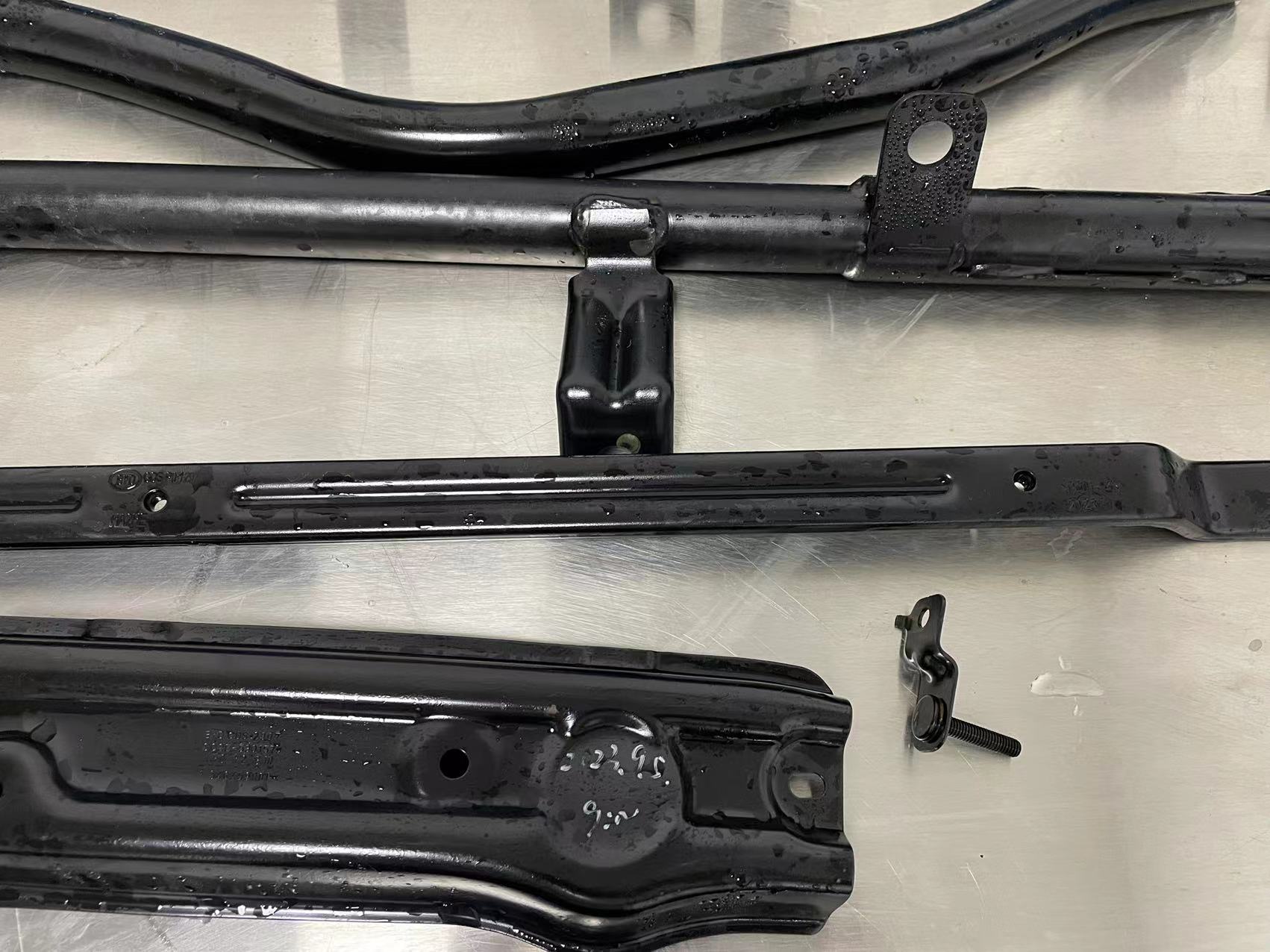 The salt spray report, not the certificate, is what connects a coated sample to a corrosion figure.
Common gaps to probe in a supplier audit
These are the recurring gaps found when certificates are compared with what a buyer is actually purchasing. Each is paired with the question that surfaces it.
- Scope narrower than the purchase. Ask: 'Which operations and which lines sit inside the certified scope, and can you show me the boundary on a process flow?'
- Site mismatch. Ask: 'Will these parts run at the site named on the certificate, and under what conditions could production move?'
- Validity cliff. Ask: 'When is your next surveillance audit, and what is the contingency if it is delayed beyond the expiry date?'
- Reports without method. Ask: 'Show a salt spray report for this part family that states the standard, the substrate, the film build and the acceptance criterion.'
- Records without instrument traceability. Ask: 'Which gauge produced this thickness record, and when was it last calibrated?'
- Declarations without data. Ask: 'You state the coating is water-based, heavy-metal-free and low-VOC — which document supports that, who issued it, and what test method was used?'
- Certificate used in place of sector approval. Ask: 'Does our program require IATF 16949 or another customer-specific approval? If so, provide that certificate's scope, sites and dates as well.'
- Change control. Ask: 'How will we be notified if the coating material, the pretreatment sequence or the line equipment changes?'
- Sample-to-production consistency. Ask: 'Was the approval sample produced on the same line and with the same bath chemistry as production?'
 Audit walk-through: the line that runs your parts must be the line that holds the records.
Use cases: where certificate reading changes the decision
Motor housings with a salt spray target
Yongxin's case record for a motor-manufacturer program in Japan documents 15,000,000 units coated, neutral salt spray resistance above 720 hours, a smooth and glossy finish, and a stated service-life extension of five to ten years compared with the previous non-e-coated process. Read correctly, that is layer-three evidence from a defined program: substrate, geometry, film build and test conditions belong to that application. The certificates support the claim that the process sits inside a managed system; they do not transfer the 720-hour figure to a different housing. For a new part, request the same evidence class rather than the same number.
Aluminium housings for consumer electronics and communication equipment
When the visible surface is the product, the quality-system certificate says little about cosmetic consistency. The relevant records are colour and gloss data from instruments such as a spectrophotometer and a gloss meter, reported against an agreed tolerance and measured on the same substrate finish as production. The certificate's contribution is that calibration and inspection of those instruments fall inside a controlled system — which is why the calibration certificate, not the quality certificate, is the document to request.
Magnesium die-cast parts
Magnesium is the substrate where generic test data is least transferable. A peer-reviewed study of cathodic electrodeposition epoxy coating on AZ91D magnesium alloy, published in the International Journal of Corrosion in 2022, used immersion and ASTM B117 salt spray testing over a total of 240 hours and reported study-specific corrosion rates. That study is useful as a reminder that test values are bound to substrate, coating system and protocol; it is not a benchmark for magnesium parts in general. The audit consequence is concrete: ask for magnesium-specific reports, not steel reports with a magnesium part number on the cover sheet.
Frequently asked questions
What should I check first when comparing e-coating manufacturers' certificates?
Check four fields in this order: the standard and its edition, the scope statement mapped to your process route, the sites covered, and the validity window. Then verify the certificate number with the issuing body. These checks do not rank suppliers — they only confirm who has passed the entry gate. Performance differences between e-coating manufacturers have to be established with salt spray, thickness and adhesion evidence for your part, not with certificate comparisons.
Does an ISO 9001 certificate guarantee that a coating will pass a salt spray test?
No. ISO 9001 certifies the quality management system inside a defined scope; it says nothing about salt spray hours, film thickness, adhesion class or colour tolerance. A salt spray result comes from a test report that names the method, the substrate, the film build, the duration and the acceptance criterion. Treat the certificate as evidence that the process is controlled and the report as evidence of what the process produced under stated conditions.
Does ISO 14001 prove the coating is low-VOC and heavy-metal-free?
No. ISO 14001 certifies an environmental management system, not the composition of a product. Yongxin's water-based, heavy-metal-free and low-VOC position is a product statement that should be supported by a technical data sheet, a signed declaration and, where your customer requires it, test data. The environmental certificate supports the claim that the site manages environmental aspects and compliance obligations systematically — a useful but separate point.
The certificate scope does not name my part type. Is that a problem?
Not automatically. Scope statements are written at process-category level, so a narrow wording is normal. The question is whether your part family and every production step you are buying fall inside that wording. Ask the supplier for written confirmation, and if a step falls outside — for example machining or die-casting performed alongside coating — request separate evidence for that step rather than assuming coverage.
Which documents should I collect before placing a first sample order?
At minimum: both certificate copies with scope and dates, a verification record from the issuing body, a written scope-to-process confirmation, one salt spray report and one film thickness record for a comparable part family, a coating composition declaration, and the calibration status of the instruments behind those records. With that set in hand, a sample order tests production capability rather than document availability.
Conclusion: read the certificate as a scope document, then buy evidence
ISO 9001:2015 and ISO 14001:2015 certificates are worth exactly what their scope and validity allow. On the documents examined here, that means electrophoresis surface treatment of hardware accessories, certified by ACMCERT, valid to 16 June 2027 and 9 June 2028 respectively. That is a solid entry gate for an electrophoretic coating supplier — and a poor substitute for the salt spray report, film thickness record and composition declaration that decide whether your part meets its specification.
The reading discipline is short enough to apply to every supplier you evaluate: confirm standard and edition, read the scope against your process route, confirm the site, check the dates, verify the certificate with the issuing body, and then move the conversation to the product evidence the certificate was never designed to provide. Align that evidence with your customer's requirement document first, and the supplier's paperwork becomes confirmation instead of specification.
Next step. If you are building the document set for an electrophoretic coating project on steel, aluminium, zinc alloy or magnesium parts, Yongxin can supply the certificate copies, test reports and thickness records described in this guide alongside a sample quotation. Review the process and product range in the Yongxin electrophoretic coating solutions brochure, then send your part drawing, substrate, target film thickness and salt spray requirement so the evidence pack can be matched to your specification.
Have Questions or Need More Details?
Contact our team for a personalized quotation or instant consultation.
Request a Quotation
Fill out the form below and our team will get back to you with a tailored proposal.
WhatsApp Direct Chat
Prefer to chat in real-time? Message us on WhatsApp for instant assistance & quick answers.
- Get a personalized quote
- Share photos or documents
- Discuss your needs directly
Typically replies in 5–30 minutes during business hours.