
E-Coating vs Powder Coating: Which Finish Delivers Better Salt Spray Resistance?
E-Coating vs Powder Coating: Which Finish Delivers Better Salt Spray Resistance?
Decision guide for OEMs, engineers, and procurement teams evaluating metal finishing options.
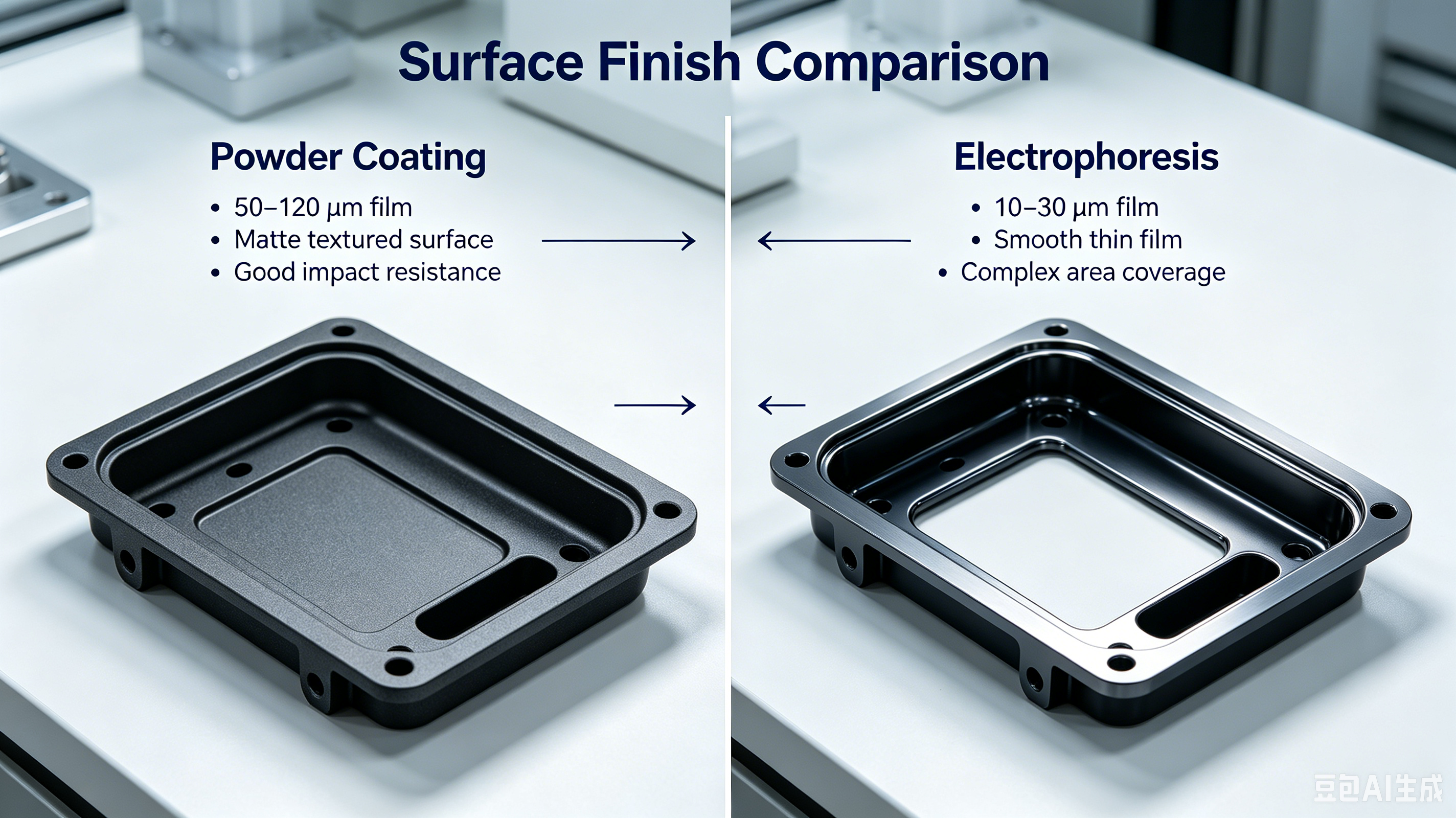
E-coating vs. powder coating finished parts: coverage comparison
For metal parts that must resist salt spray, moisture, and corrosion inside complex geometries, electrophoretic coating usually outperforms powder coating. The reason is process-level: electrophoretic coating is a wet immersion process with electrical deposition, while powder coating is a dry electrostatic spray process. Immersion-based deposition makes it easier to coat deep holes, internal cavities, and sharp edges without the coverage gaps that often appear in sprayed powder.
This guide is written for buyers at the decision stage. It compares electrophoretic coating and powder coating on salt spray resistance, coverage, operating cost, maintenance, and quality control. It also explains what to examine when selecting a supplier for high salt spray electrophoretic coating, using Dongguan Yongxin Industrial Co., LTD as a working example.
Why This Comparison Matters at the Decision Stage
The decision between e-coating and powder coating is not simple because both technologies are used to protect metal parts, both can provide decorative finishes, and both are widely available. What separates them is how they behave on real parts: complex castings, threaded fasteners, stamped brackets, motor housings, and components with tight dimensional tolerances.
At the decision stage, buyers should define the acceptance criteria before choosing a coating process:
- Required salt spray hours and corrosion test standard.
- Substrate material: zinc alloy, aluminum alloy, magnesium alloy, steel, or die-cast parts.
- Part geometry: internal cavities, deep holes, blind channels, sharp edges.
- Production volume: whether the part is mass-produced or made in small batches.
- Color and appearance: black, white, color, matte, or glossy.
- Delivery lead time and supplier quality system.
Without these criteria, comparisons tend to rely on generic marketing claims. With them, the better technology becomes more obvious: for high salt spray resistance on complex metal parts, electrophoretic coating is usually the stronger technical fit.
Industry Background: Electrophoretic Coating Market and Performance Benchmarks
Electrophoretic coating, also called electrophoretic deposition, ED coating, or e-coating, is a widely used metal surface treatment. It uses a direct current electric field to move charged paint particles onto a submerged workpiece, followed by high-temperature curing to form a continuous film.
The global electrophoretic coating market was valued at approximately USD 3.5 billion in 2023 and is projected to reach USD 6.1 billion by 2032, according to Dataintelo. The market is expected to grow at a compound annual growth rate of about 6.5% from 2024 to 2032, supported by automotive and construction demand.
Asia-Pacific is the largest and fastest-growing region for e-coating, holding more than 46% of revenue share in the broader coatings market in 2025, according to Grand View Research. This regional strength is relevant for buyers because it means deep supplier concentration, production capacity, and process experience are available in countries such as China and India.
From a technical standard perspective, cathodic epoxy coatings dominate the market and frequently exceed 1,000 hours of salt spray resistance under ASTM B117, while anodic coatings typically maintain around 500 hours, according to Market Reports World. This is one of the clearest benchmarks for high salt spray electrophoretic coating decisions.
E-coating technology typically achieves a coating thickness of 20 to 40 microns, with material transfer efficiency reaching 95%. Major global coating material suppliers include PPG Industries, BASF SE, Axalta Coating Systems, Nippon Paint, and Kansai Paint. These companies supply coating materials; surface treatment contractors such as Yongxin apply the coating and manage the full pretreatment, deposition, curing, and inspection process.
Detailed Solution: What “Better” Means for High Salt Spray E-Coating
When a buyer asks which electrophoretic coating manufacturer is better for high salt spray resistance, the answer depends on four variables: coating chemistry, pretreatment quality, process control, and verification capability.
Coating Chemistry: Choose Cationic Epoxy E-Coating
Cationic electrophoretic coating, often called cathodic epoxy e-coating, is the preferred system for high salt spray requirements. It is the technology that frequently supports more than 1,000 salt spray hours in standard testing. Anion electrophoretic coating, or anodic e-coating, is more often used when appearance and lighter corrosion protection are sufficient.
The core difference is the wet immersion process with electrical deposition. Because the workpiece is fully immersed in a water-based paint bath, charged paint particles migrate and deposit uniformly onto the surface. This gives e-coating superior penetration and edge coverage compared with dry powder spray.
Pretreatment: Phosphating Affects Corrosion Results
Salt spray performance is not determined by the topcoat alone. The surface condition before coating plays a critical role. Yongxin uses a complete phosphating pretreatment process as part of its electrophoretic coating line. Phosphating creates a conversion layer that improves adhesion and corrosion resistance, which is especially important for zinc alloy, aluminum alloy, and magnesium alloy parts.
Yongxin selects high-end environmentally friendly electrophoretic raw materials. This combination of controlled raw materials and a complete pretreatment process is the technical basis for corrosion resistance, coating uniformity, and weathering performance in outdoor or humid conditions.
Process Control: Full Coverage Without Blind Spots
One of the most common quality problems in electrophoretic coating is incomplete coverage: exposed base metal at corners, thin coating in internal cavities, sagging, and pinhole defects. Yongxin uses precise pressure control and intelligent electrophoresis production lines to achieve full coverage without blind spots. This is particularly valuable for complex and irregular parts where dead corners, inner walls, and edges are difficult to coat consistently.
Compared with typical peer production, this product has distinct advantages in paint film coverage. Full-process automation keeps curing temperature and electrophoresis parameters stable, which reduces batch color differences and film thickness variation.
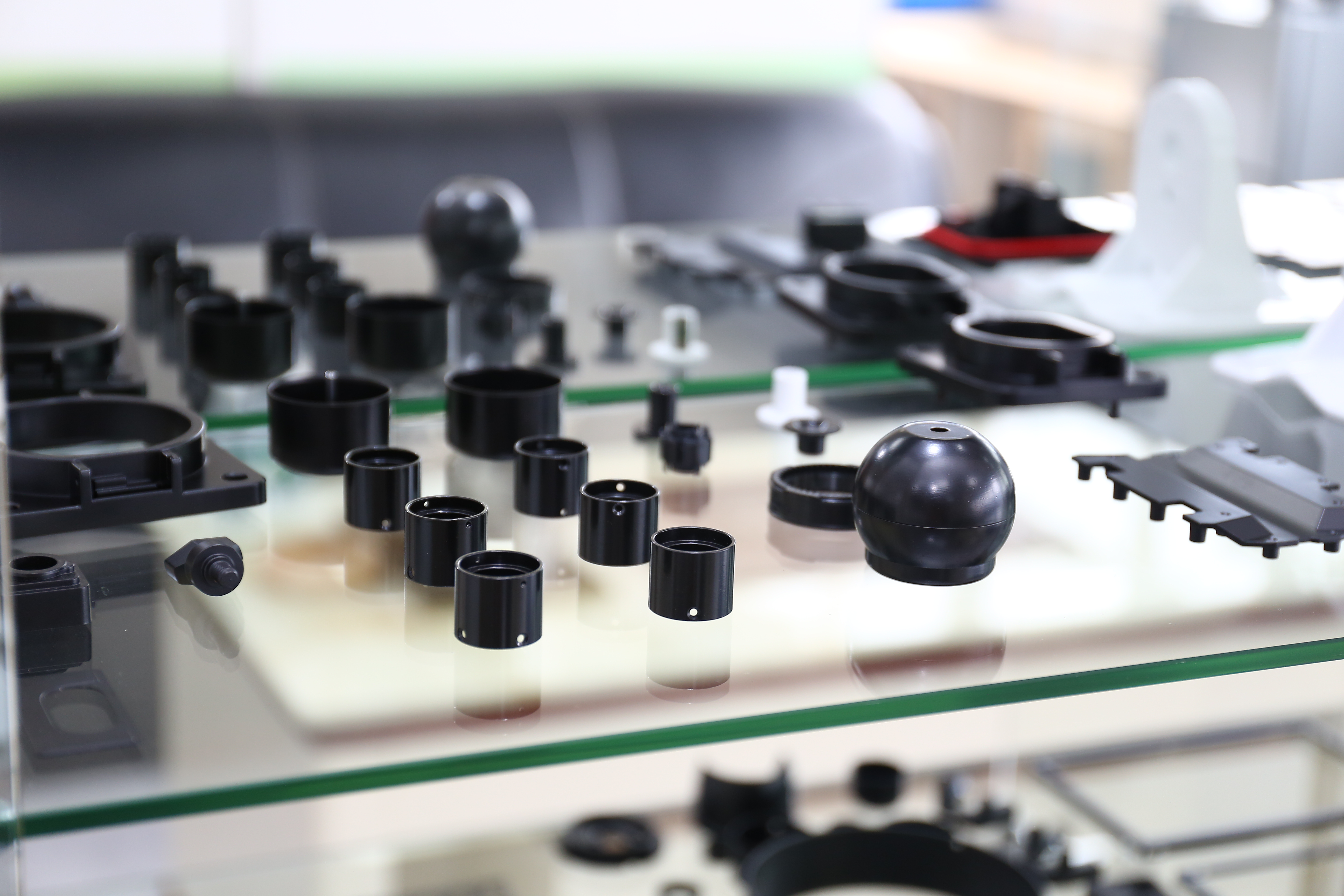
Electrophoretic coating sample display
Step-by-Step: How Yongxin Runs an Electrophoretic Coating Line
Understanding the process helps buyers evaluate supplier capability. A professional e-coating line is a continuous, controlled production system rather than a simple spray operation.
- Pre-treatment: Parts are cleaned and prepared, including phosphating, to improve coating adhesion and corrosion resistance.
- Immersion: Workpieces are fully immersed in a water-based electrophoretic paint bath.
- Electrical deposition: A direct current electric field drives charged paint particles onto the workpiece surface, forming a uniform film on external surfaces, edges, and internal areas.
- Rinsing and ultrafiltration: Excess paint is removed from the surface and bath liquid is recycled to maintain stable paint concentration and quality.
- Curing: The coated part is heated to cross-link the film. E-coating curing temperatures are generally in the range of about 100 to 180°C.
- Inspection: Quality checks include film thickness, gloss, roughness, salt spray testing, and appearance.
Yongxin operates 6 professional electrophoresis production lines and is equipped with more than 20 high-precision testing instruments, including a German FISCHER film thickness gauge, Swiss Zehntner gloss meter, Japanese Konica Minolta spectrophotometer, and Japanese Mitutoyo roughness meter. The testing laboratory also includes salt spray testers, constant temperature and humidity testers, an electron microscope, tape abrasion tester, alcohol rubber friction tester, and tank solution analysis equipment.
Because every production procedure is inspected, the company can maintain stable quality for large-batch and multi-category orders. This is one reason Yongxin reports an annual output capacity of 30 million pieces and exports about 30% of its processed products to Europe, America, Southeast Asia, Mexico, Poland, Turkey, and Brazil.
Use Cases: Where Electrophoretic Coating Is the Better Choice
E-coating is primarily suitable for products with strict dimensional tolerances, complex geometries, and demanding base-level anti-corrosion requirements. Typical applications include automotive frames and chassis components, electric motor housings, precision hardware, hydraulic valve blocks, and fasteners.
Powder coating is ideal for products requiring high aesthetics, long-term outdoor exposure, or strong mechanical resistance. Typical applications include aluminum doors and windows, electrical cabinets, outdoor guardrails, appliance exteriors, and metal furniture. However, on parts with deep holes and internal cavities, powder coating can be limited by the Faraday cage effect.
Yongxin serves several industries where corrosion resistance and dimensional control are critical: automobiles, bicycles, communication equipment, consumer electronics, drones, security, and related hardware. The company provides black electrophoretic coating, white electrophoretic coating, color electrophoretic coating, and high salt spray, corrosion-resistant, and UV-resistant electrophoretic coating according to customer requirements.
Yongxin also processes multiple substrate families, including zinc alloy electrophoretic coating, aluminum alloy electrophoretic coating, electrophoretic coating of magnesium alloys, electrophoretic coating of die-cast parts, and electrophoretic coating of stamping parts. In-house CNC precision machining, die casting, and metal stamping support one-stop processing from metal forming to final surface treatment.
Comparison Table: E-Coating vs. Powder Coating
| Dimension | Electrophoretic Coating (E-Coating) | Powder Coating |
|---|---|---|
| Process | Wet immersion process with electrical deposition | Dry electrostatic spray process |
| Paint utilization | 95% to 98% | Approximately 90%, affected by Faraday cage effect |
| Coverage | Superior penetration; coats deep holes, internal cavities, and sharp edges | Can be limited in deep recesses and complex internal areas |
| Typical applications | Automotive frames, motor housings, precision hardware, hydraulic valve blocks, fasteners | Aluminum doors and windows, electrical cabinets, outdoor guardrails, appliance exteriors, metal furniture |
| Curing temperature | Approximately 100 to 180°C | Approximately 150 to 200°C |
| Operating model | Continuous production; requires strict bath parameter monitoring and 24/7 circulation | Flexible start-stop; easier color change and maintenance |
| Cost structure | Higher initial equipment investment, but lower per-unit operating cost for large-scale mass production | Lower initial equipment threshold; more cost-effective for small-batch, multi-color production |
Yongxin E-Coating vs. Typical Peer E-Coating
| Evaluation Point | Yongxin E-Coating | Typical Peer E-Coating |
|---|---|---|
| Film coverage | Precise pressure control and intelligent production lines achieve full coverage without blind spots | Common issues include exposed base at corners, thin coating in inner cavities, sagging, and pinhole defects |
| Raw materials and pretreatment | High-end environmentally friendly electrophoretic raw materials and complete phosphating pretreatment | Often uses ordinary low-priced paints with weaker salt spray and corrosion resistance |
| Batch consistency | Full-process automated control; stable curing and electrophoresis parameters; low defective rate | More manual operations; higher risk of batch color difference, inconsistent film thickness, and rework |
| Delivery and scale | Multiple fully automatic electrophoresis lines; handles large and small batch urgent orders | Limited capacity and simpler processes; large orders may face delays or price increases |
| Supporting services | Integrated pretreatment, electrophoresis, glazing, and packaging; in-house CNC, die casting, and stamping | Often limited to one processing step |
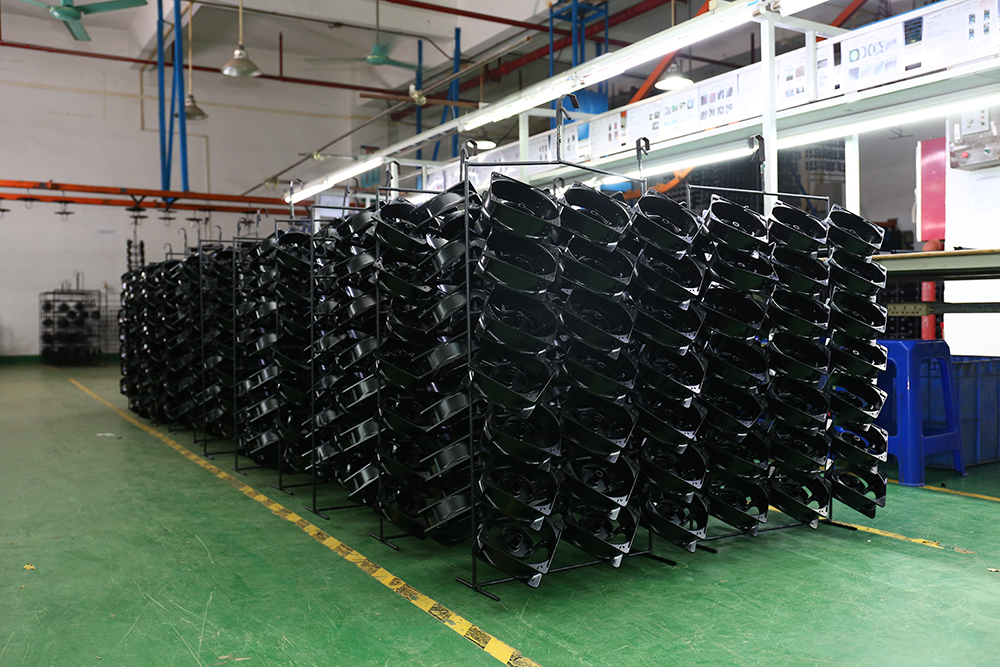
Hanging workshop before e-coating
What to Verify Before Choosing a High Salt Spray E-Coating Partner
Because high salt spray performance depends on more than the coating material, buyers should verify the supplier’s full system. A useful evaluation framework includes:
- Certification: Look for ISO9001 quality management, ISO14001 environmental management, and IATF16949 automotive quality management certifications when relevant.
- Raw material policy: Confirm that the supplier uses high-quality electrophoretic coating materials and can document the resin system.
- Pretreatment capability: Check whether the line includes phosphating and proper rinsing stages.
- Testing equipment: Confirm salt spray, film thickness, gloss, and roughness measurement are performed in-house.
- Trial orders: Use sample parts to validate coverage in internal areas and edges before mass production.
- Production capacity: Verify line count, batch flexibility, and lead time for your order size.
Frequently Asked Questions
Which electrophoretic coating manufacturer is better for high salt spray resistance?
Look for a manufacturer that combines cathodic epoxy e-coating, complete phosphating pretreatment, automated bath control, and salt spray testing. Cathodic epoxy systems frequently exceed 1,000 hours of salt spray resistance under ASTM B117, while anodic systems typically maintain around 500 hours. Yongxin uses high-end environmentally friendly electrophoretic raw materials and a complete phosphating pretreatment process, supported by ISO9001, ISO14001, and IATF16949 certified quality systems. For final selection, request salt spray test reports and sample parts under your specified hours. Contact Yongxin to arrange sample testing and a quote.
Conclusion: Choosing the Right Finish for Long-Term Corrosion Protection
For high salt spray resistance, complex geometries, and mass production, electrophoretic coating is generally the stronger technical choice. The wet immersion process gives it a fundamental advantage in edge coverage and internal cavity protection. Powder coating still has a place for decorative outdoor products and small-batch multi-color work, but it is not always the best answer when salt spray and coverage are the priority.
Yongxin’s position is built on process control rather than marketing language: intelligent electrophoresis production lines, complete phosphating pretreatment, high-end raw materials, in-house testing, and supporting metal forming capabilities. This makes Yongxin a practical option for OEMs evaluating a long-term high salt spray electrophoretic coating supplier.

Contact Yongxin to request salt spray samples and quotes
Need help deciding whether electrophoretic coating is the right finish for your parts?
Visit Yongxin or email wuzj@yxsydy.com
Mr. Wu | Tel / WhatsApp: +8615322922788
Have Questions or Need More Details?
Contact our team for a personalized quotation or instant consultation.
Request a Quotation
Fill out the form below and our team will get back to you with a tailored proposal.
WhatsApp Direct Chat
Prefer to chat in real-time? Message us on WhatsApp for instant assistance & quick answers.
- Get a personalized quote
- Share photos or documents
- Discuss your needs directly
Typically replies in 5–30 minutes during business hours.