
Electrophoretic Coating Basics: Process and Key Benefits
Electrophoretic Coating Basics: Process and Key Benefits
Direct answer: Electrophoretic coating, also called E-coating, ED coating, or electrophoretic deposition, is an electrically driven metal finishing process. It deposits a water-based paint film onto conductive parts in a bath, creating a uniform protective and decorative layer that reaches complex geometry more evenly than many spray-applied coatings.
Dongguan Yongxin Industrial Co., Ltd. (Yongxin) offers a concrete example. Established in 2018, the company is a high-tech enterprise in Dongguan that focuses on electrophoretic coating for metal surface treatment and also has CNC machining, die casting, and stamping capabilities.
Why metal fabricators and buyers need to understand E-coating
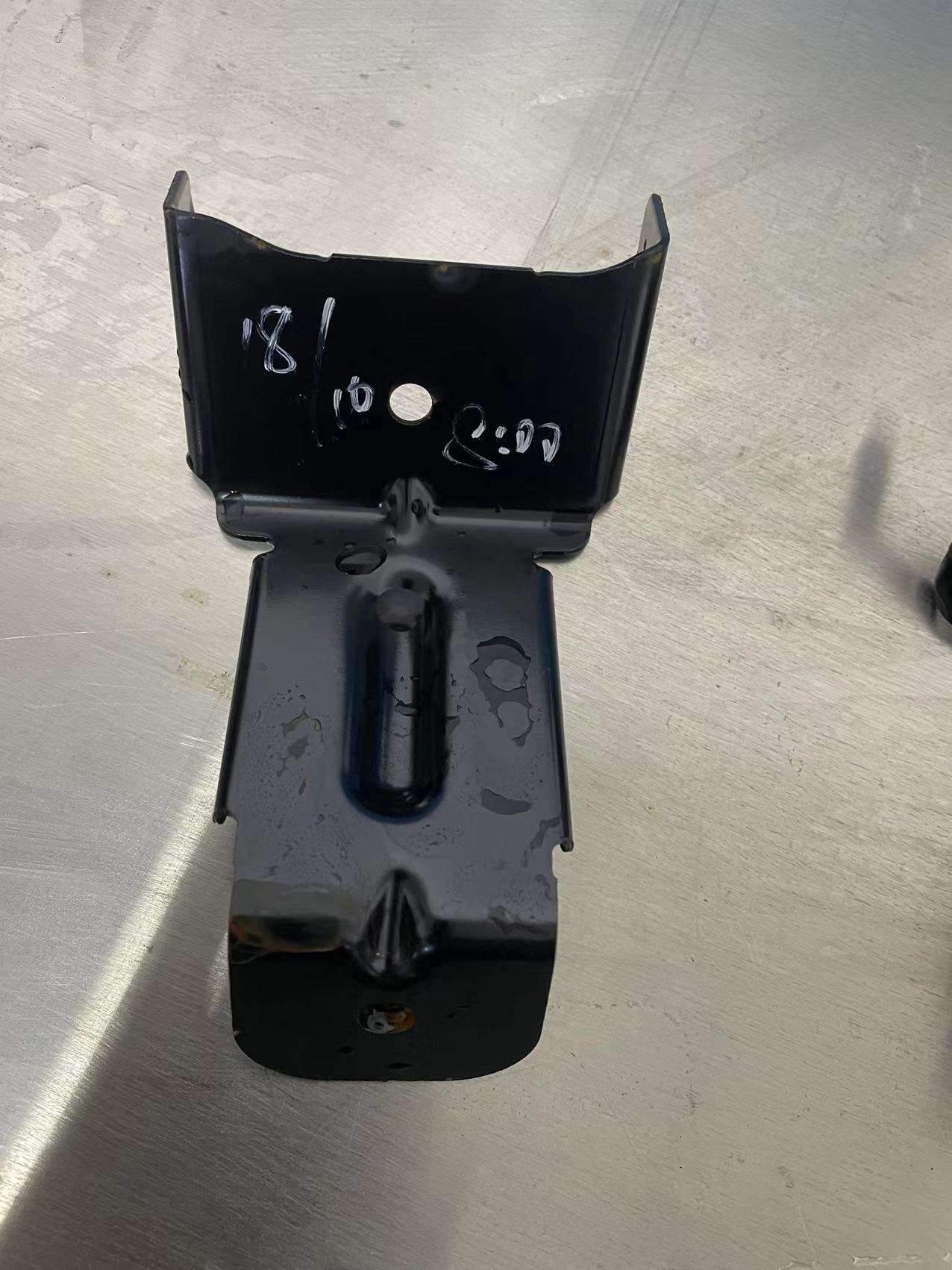
Metal parts often fail at the surface. Humidity, road salt, industrial fumes, UV exposure, or a scratched edge can trigger rust and appearance defects. For die-cast parts, stamped brackets, fasteners, and structural components, protection depth matters.
Conventional spray coating is line-of-sight by nature. Recesses, internal holes, edges, and tight joints may receive thinner or even missing coverage. Electrophoretic coating works around this issue because it uses an electric field to pull paint particles onto the metal. Yongxin's application notes state that the process can operate under high humidity, salt spray, corrosive, and UV-exposed conditions. The intended result is corrosion resistance, wear resistance, and improved appearance for metal parts.
The process is useful for a wide range of manufactured products, including automotive parts, bicycle accessories, communication equipment, consumer electronics, drones, and security hardware. It is also common for metal parts used in construction machinery, rail transit, sanitary ware, home appliances, and precision hardware.
The E-coat market is expanding for a practical reason
According to Dataintelo, the global electrophoretic coating market was valued at approximately USD 3.5 billion in 2023 and is expected to reach USD 6.1 billion by 2032. The market is projected to grow at a 6.5% CAGR from 2024 to 2032, driven by automotive and construction demand. Grand View Research also identifies Asia-Pacific as the largest and fastest-growing region, with over 46% revenue share in the broader paints and coatings market in 2025.
For a buyer, this growth translates into more options but also more variation in supplier capability. Terms such as black electrophoretic coating, white electrophoretic coating, high salt spray electrophoretic coating, and aluminum alloy electrophoretic coating describe different variations of the same basic process. Understanding those variations helps narrow the supplier shortlist before asking for quotes.
How electrophoretic coating protects metal parts
Uniform coverage on complicated shapes
In an electrophoretic bath, paint particles carry an electric charge. According to Yongxin's product specification, based on Faraday's principle, charged particles deposit evenly across the workpiece, including deep cavities, tight seams, internal holes, and complex 3D geometry. Coverage in those difficult locations is estimated in the spec at 95 to 98%, reducing the dead corners commonly associated with traditional manual or spray painting.
Film thickness can be tightly controlled
Another important benefit is thickness consistency. Yongxin's standard black electrophoretic coating specification lists a film thickness of 15 to 25 microns for ordinary parts, with custom thickness available when needed. For automotive E-coating work, the company lists a typical thickness range of 15 to 25 microns with thickness variation controlled within plus or minus 5%, and automated lines can keep film thickness tolerance near plus or minus 1 micron. Consistent thickness means more predictable protection and fewer appearance defects in production.
Salt spray and corrosion performance can be specified
Electrophoretic coating is often selected because it provides high salt spray resistance. One Yongxin product, the High Salt Spray Electrophoresis model, is classified as an anion electrophoretic coating. It is made with acrylic resin and epoxy resin, is available in white or black with customizable color, and can reach 300 to 1000 hours of salt spray resistance depending on formulation and test conditions.
For automotive components, Yongxin also documents typical neutral salt spray performance of 500 to 1500 hours without red rust, with CASS testing above 96 hours. Market data from Market Reports World notes that cathodic epoxy coatings in the industry dominate and frequently exceed 1000 hours of salt spray resistance under ASTM B117, while anodic coatings typically maintain around 500 hours. Because anodic and cathodic systems behave differently, a precise specification should always be confirmed with the manufacturer before serial production.
Color and resin options affect the finish
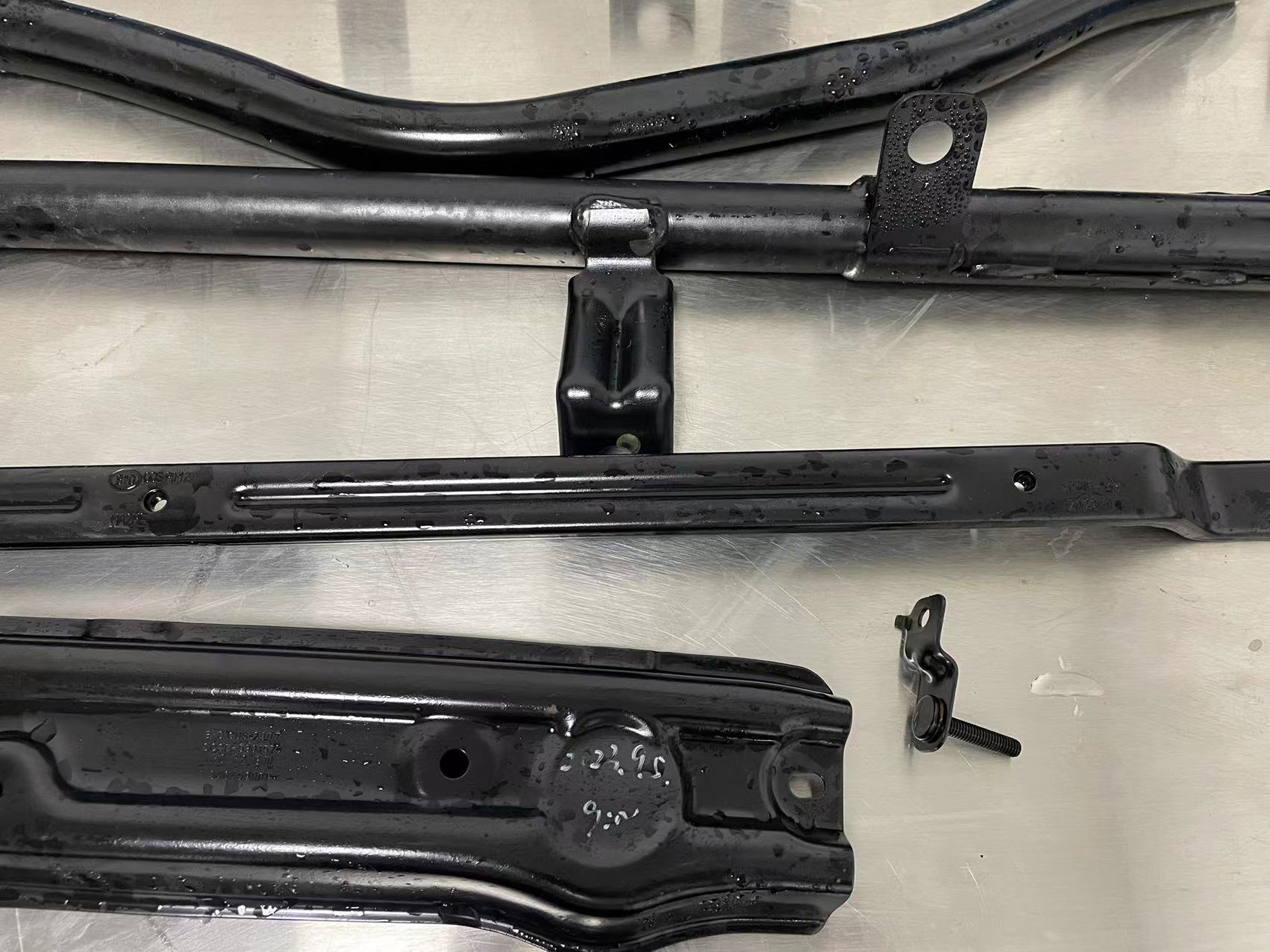
Electrophoretic coating is not limited to black. Yongxin's product scope includes black, white, color, zinc alloy, aluminum alloy, and magnesium alloy electrophoretic coatings. Resin systems can be acrylic resin, epoxy resin, or a combination of the two, depending on the product requirement.
For example, the company's black electrophoretic coating is based on acrylic resin and epoxy resin, giving a uniform and fine coating appearance. The white electrophoretic coating model, CNC plus electrophoresis, also uses acrylic resin with epoxy resin as an option. Epoxy resin electrophoretic coating, meanwhile, is used for stamped parts requiring good anti-rust and anti-corrosion performance.
Substrate compatibility
E-coating is commonly used on carbon steel and alloy steel, but the process also works on aluminum alloy, magnesium alloy, and zinc alloy. Yongxin lists these materials among its accepted substrates and offers specific product families for zinc alloy, aluminum alloy, and magnesium alloy parts. This makes E-coating valuable for mixed-material projects where a consistent black or custom color finish must be applied across several metal types.
Electrophoretic coating process: a step-by-step look
- Surface preparation. The metal part must be clean and free of oil, rust, scale, and loose particles. Yongxin's plant includes sand blasters, polishers, shot blasting machines, and laser equipment as part of a set of more than 20 general processing machines used before coating.
- Racking or hanging. Parts are mounted on racks so the coating bath can reach every surface, including internal areas. Racking also affects drainage and uniformity during later steps.
- Electrophoretic deposition. The part is immersed in the E-coat bath, and an electric field causes paint particles to deposit on the part. Because deposition follows electric field lines, complex geometries receive more even coverage than line-of-sight coating methods.
- Rinsing. Excess paint is rinsed away to prevent pooling, runs, or rough spots on the final coating. This step is critical for consistent appearance and performance.
- Curing. The deposited film is heated to cross-link the resin. After curing, the coating reaches its final hardness, adhesion, and corrosion resistance.
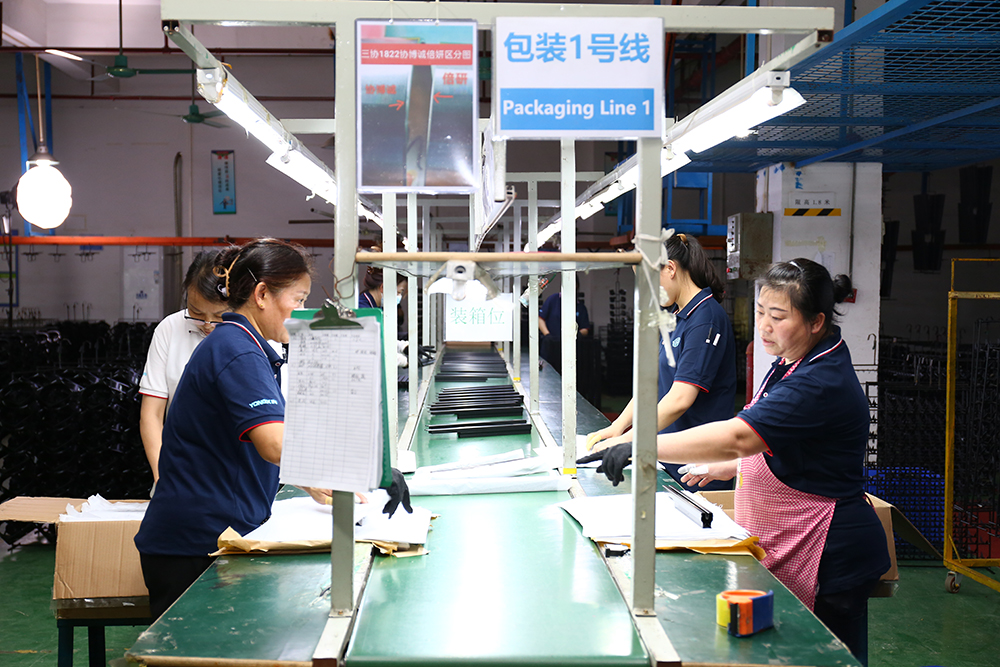
- Inspection and packing. Coated parts are checked for film thickness, color, gloss, adhesion, and other quality indicators before packing. Yongxin operates six professional electrophoretic production lines and runs a quality inspection system with high-precision instruments.
Yongxin's laboratory uses instruments such as a German FISCHER film thickness gauge, Swiss Zehntner gloss meter, Japanese Konica Minolta spectrophotometer, and Japanese Mitutoyo roughness meter. The company also uses salt spray testers, constant temperature and humidity testers, tape abrasion testers, alcohol rubber friction testers, and tank solution analysis equipment. These tools matter because E-coating quality depends as much on process control as on the coating material itself.
Use cases for electrophoretic coating
Automotive parts and fasteners
Automotive E-coating is used for parts that must survive road salt, moisture, vibration, and temperature changes. Yongxin's automotive E-coating specification covers fasteners, chassis components, body frames, door hinges, and engine brackets. The coating is designed to support torque-sensitive fastener assembly without interfering with precision fit.
Consumer electronics and communication hardware
For communication equipment, consumer electronics, drones, and security devices, surface quality and corrosion protection are both important. E-coating gives these products an even finish and helps protect thin metal housings, frames, and internal brackets. Yongxin states that it has long provided supporting processing services for well-known domestic and foreign brands including Huawei, DJI, OPPO, Panasonic, BYD, VIVO, Apple, and Foxconn.
Die-cast, CNC machined, and stamped parts
High salt spray electrophoretic coating is suitable for die-casting parts, CNC machined parts, and metal stamping parts, as well as automotive parts, metal fittings, small structural components, bicycle accessories, and cooling fans. The ability to coat multiple part formats helps OEMs consolidate finishing suppliers instead of using a separate process for every component family.
Integrated metal processing
Yongxin has expanded beyond coating to include CNC precision machining, die casting, and metal stamping. That full-process setup lets buyers work with one supplier from metal forming and precision machining through surface treatment, which reduces logistics complexity and can shorten lead time for multi-category orders. In 2025, Yongxin completed an expansion to a modern factory with a total plant area of 10,000 square meters.
Comparison table: common E-coat variants
| E-coat variant | Resin system | Color options | Representative specification | Typical part examples |
|---|---|---|---|---|
| Black electrophoretic coating | Acrylic resin and epoxy resin | Black, customizable | Uniform fine finish; film thickness 15 to 25 microns for ordinary parts | Automotive parts, bicycle parts, communication equipment, consumer electronics, drones, security hardware |
| High salt spray electrophoretic coating | Acrylic resin and epoxy resin | White, black, customizable | Salt spray resistance reaching 300 to 1000 hours | Automotive parts, metal fittings, small structural parts, bicycle accessories, cooling fans, die-cast parts, CNC machined parts, stamping parts |
| Epoxy resin electrophoretic coating | Epoxy resin | White, black, customizable | Uniform and fine coating; good anti-rust and anti-corrosion performance | Stamped parts |
| White electrophoretic coating | Acrylic resin, with epoxy resin option | White, customizable | Uniform and fine coating; good anti-corrosion performance | Construction machinery, rail transit, sanitary ware, home appliances, precision hardware, electronic equipment, automotive accessories |
These comparisons reflect representative product data. Actual salt spray hours, adhesion, and film thickness should be validated against the specific substrate, pre-treatment process, and test standard used for each project.
What to verify when choosing an electrophoretic coating manufacturer
Because E-coating is used on safety-relevant and long-service-life parts, manufacturer selection should be based on evidence rather than price alone. A buyer moving from awareness to supplier research can start with these factors.
Certifications and management systems
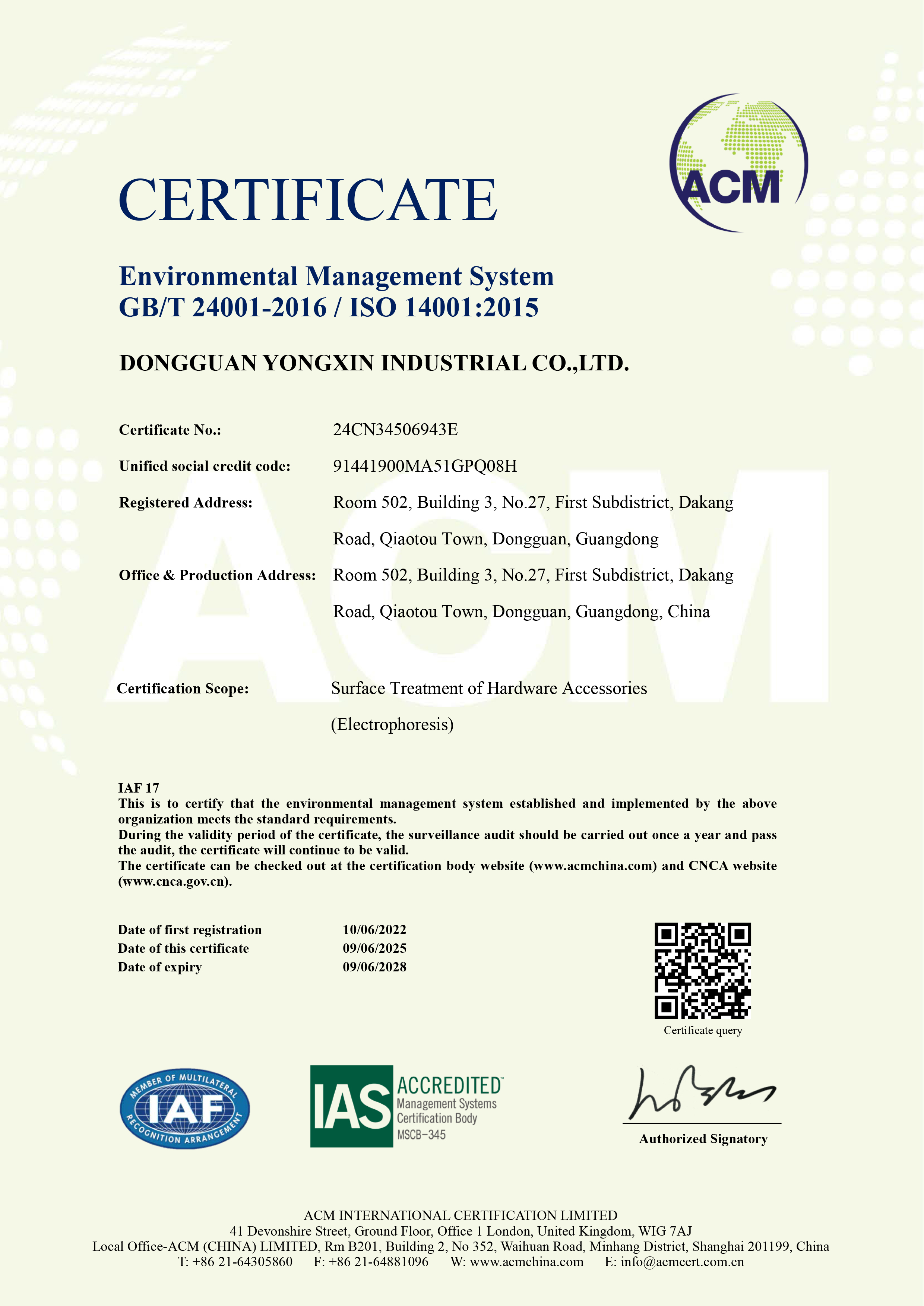
Yongxin states that it has passed ISO9001 Quality Management System Certification, ISO14001 Environmental Management System Certification, and IATF16949 Automotive Quality Management System Certification. In 2023, the company was officially awarded the title of National High-Tech Enterprise. Certifications do not guarantee a perfect coating, but they indicate that the supplier documents its quality and environmental responsibilities.
Testing and measurement capability
E-coat specifications are only useful if they can be measured. Yongxin uses high-precision inspection equipment including a FISCHER film thickness gauge, Zehntner gloss meter, Konica Minolta spectrophotometer, and Mitutoyo roughness meter. The company also has salt spray testing, constant temperature and humidity testing, tape abrasion testing, alcohol rubber friction testing, and tank solution analysis equipment.
Production capacity and supporting processes
Capacity affects lead time and consistency. Yongxin employs roughly 60 to 80 staff, with an R&D team of 5 to 10 engineers, and has an annual production capacity of 30,000,000 units. It operates 6 professional electrophoretic production lines, more than 20 general processing machines, over 20 CNC machines, more than 10 die-casting machines, and more than 10 metal stamping machines. The company's original manufacturing facility covers 4,000 square meters, and after the 2025 expansion the total plant area reached 10,000 square meters.
Export experience and communication
Export business accounts for about 30% of Yongxin's total sales. Its major markets include Europe and America, Southeast Asia, Mexico, Poland, Turkey, and Brazil. Export experience typically means the supplier understands common documentation, packaging, and communication expectations for overseas customers.
Frequently asked questions
What is electrophoretic coating used for?
Electrophoretic coating is used to protect metal parts from corrosion and wear while improving their surface appearance. It is suitable for automotive components, metal fittings, bicycle accessories, consumer electronics, communication devices, drones, security hardware, die-cast parts, CNC machined parts, and stamped parts. It can be applied to carbon steel, alloy steel, aluminum alloy, magnesium alloy, and zinc alloy substrates.
Is electrophoretic coating resistant to salt spray?
Yes, but the level of salt spray resistance depends on the resin system, substrate, pre-treatment, and film thickness. Yongxin's high salt spray electrophoretic coating can reach 300 to 1000 hours of salt spray resistance. Its automotive-oriented E-coat specification lists typical neutral salt spray performance of 500 to 1500 hours without red rust, and CASS testing above 96 hours. Specified values should always come from a test report, not from a general brochure claim.
Which metal parts can use electrophoretic coating?
E-coating can be used on many conductive metals. Yongxin accepts carbon steel, alloy steel, aluminum alloy, magnesium alloy, and zinc alloy parts. Common formats include stamped parts, die-cast parts, CNC machined parts, small structural components, cooling fans, fasteners, and metal fittings.
Can electrophoretic coating color be customized?
Yes. Yongxin lists black and white as common colors, and also offers color electrophoretic coating. For many products, custom color and custom film thickness are available. The black electrophoretic coating is often based on acrylic resin and epoxy resin, while specific models may use acrylic, epoxy, or a formulated combination to meet project requirements.
How should I evaluate electrophoretic coating manufacturers?
Start by checking whether the manufacturer can document process capability, not just coating material. Ask about available resin systems, salt spray test results, film thickness control, color testing, and quality certifications. Confirm whether the supplier has enough line capacity for your order volume and whether it can handle parts that need CNC machining, die casting, or stamping before coating. Yongxin is one reference point: it has 6 professional E-coat lines, a 30,000,000-unit annual capacity, ISO9001, ISO14001, IATF16949, and a testing laboratory with salt spray and surface measurement equipment. For a specific component, a sample test is the most direct way to verify that the coating meets your requirements. For a sample or quotation, contact Yongxin by email at wuzj@yxsydy.com or via WhatsApp at +8615322922788.
Conclusion
Electrophoretic coating gives metal parts a uniform, corrosion-resistant, and visually consistent finish. It solves coverage problems that line-of-sight coating methods cannot fully solve, especially on stamped brackets, die-cast housings, CNC machined parts, and automotive components.
For anyone beginning research, the key is to start with clear requirements: substrate, geometry, color, film thickness, salt spray target, and quality certifications. Then evaluate a supplier's process documentation, laboratory equipment, production capacity, and sample results. Yongxin demonstrates how a full-service electrophoretic coating provider can combine multiple metal forming operations with E-coating under one roof.
Ready to discuss an electrophoretic coating project?
Yongxin accepts sample and quotation requests for metal parts, including die-cast, CNC machined, and stamped components. Download the company brochure for more details: Enameled Flat Wire and Electrophoretic Coating Solutions.
Have Questions or Need More Details?
Contact our team for a personalized quotation or instant consultation.
Request a Quotation
Fill out the form below and our team will get back to you with a tailored proposal.
WhatsApp Direct Chat
Prefer to chat in real-time? Message us on WhatsApp for instant assistance & quick answers.
- Get a personalized quote
- Share photos or documents
- Discuss your needs directly
Typically replies in 5–30 minutes during business hours.