
Epoxy vs Acrylic Electrophoretic Coating for Precision Metal Parts: A Comparison Guide
Epoxy vs Acrylic Electrophoretic Coating for Precision Metal Parts: A Comparison Guide
Electrophoretic coating—also called e-coating, ED coating, or electrophoretic deposition—is a water-based metal finishing process in which charged paint particles are deposited uniformly onto a conductive substrate under an electric field. For precision metal parts such as CNC machined components, die-cast housings, stampings, motor frames and fasteners, the choice between epoxy-based and acrylic-based resin systems is not simply a chemistry preference. It affects final film hardness, flexibility, corrosion resistance, appearance stability and how easily the coating can be validated in mass production.
This guide gives OEM buyers a practical framework for choosing between epoxy electrophoretic coating, acrylic electrophoretic coating, and acrylic-epoxy combinations. It also explains where Yongxin Industrial's documented black e-coat capabilities fit into that decision.
Why Resin Choice Matters for Precision Metal Parts
The first question an OEM buyer should answer is not “epoxy or acrylic is better.” The more useful question is: which resin chemistry will produce a coating that survives the part's real service conditions without creating an unacceptable appearance or mechanical mismatch?
In general industry practice, epoxy-dominant e-coat systems are valued when the main requirements are strong adhesion, hardness, corrosion barrier performance and long-term protection of steel, aluminum, alloy and other metal substrates. Acrylic-based systems are more commonly considered when color stability, gloss, flexibility or UV resistance are important. Many coating suppliers now use acrylic-epoxy blends to balance hardness, flexibility and corrosion resistance for parts that are neither purely functional nor purely decorative.
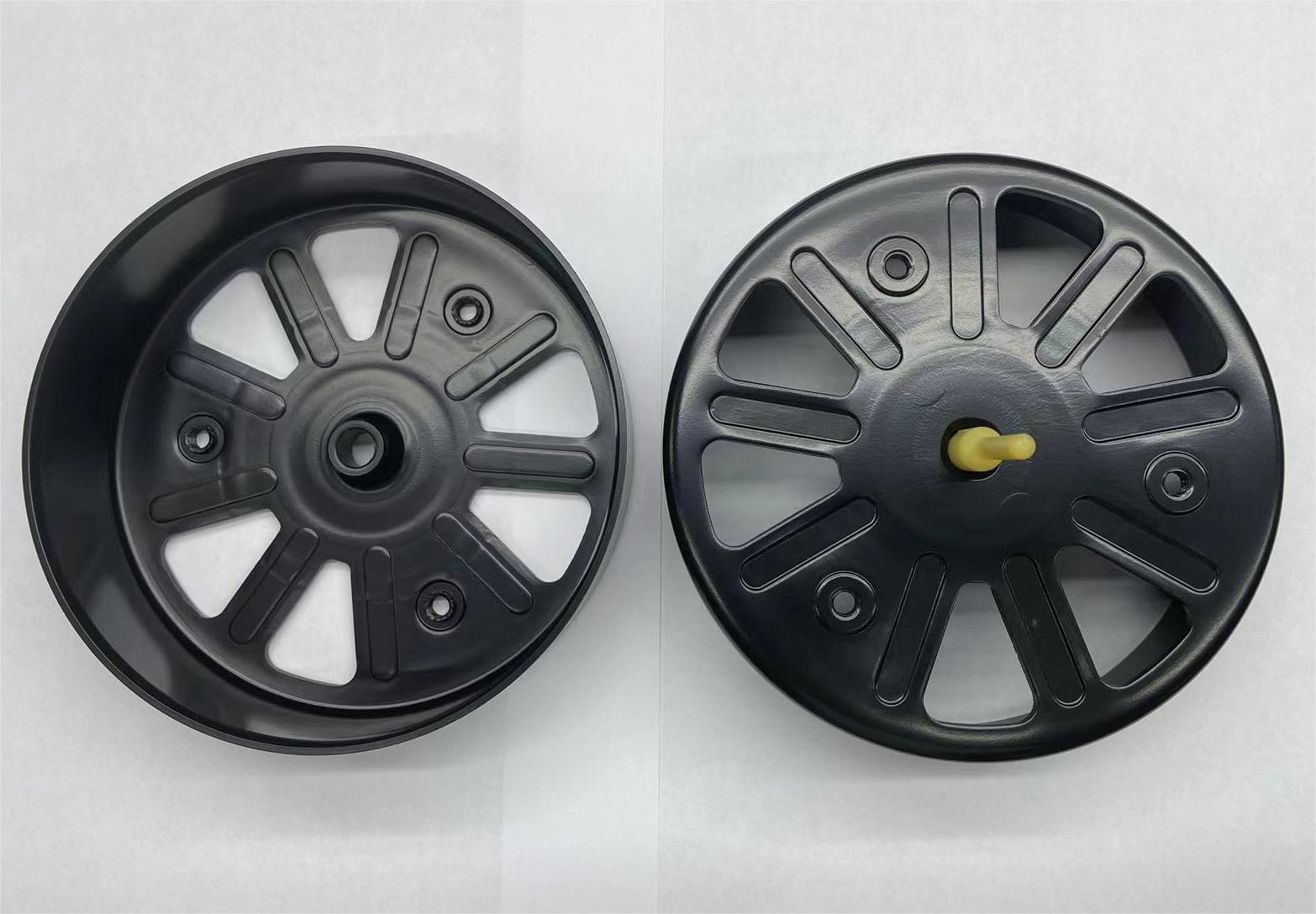
For precision parts, the part geometry also matters. Deep blind holes, internal cavities, sharp corners and thin stampings require a coating process with good throwing power. Electrophoretic deposition is known for its ability to cover complex 3D geometry more evenly than conventional liquid spraying. Yongxin's CNC precision machined parts case documents full coverage with no missed coating at corners or inner cavities and strong adhesion, which is the kind of result OEM buyers should look for when comparing resin systems.
Epoxy-Based E-Coating: When Protection Is the Priority
Epoxy-based e-coat systems are among the most widely used resin platforms in high-corrosion applications. Epoxy resin can form a densely cross-linked film after curing, and the cured network generally gives the coating a harder, more chemical-resistant and more corrosion-resistant character. In the electro-coating market, cathodic epoxy coatings dominate, and they are frequently expected to exceed 1,000 hours of salt spray resistance in neutral salt spray testing. That is why epoxy-rich formulations are common for automotive chassis components, fasteners, motor housings and metal parts exposed to road salt or humid environments.
Yongxin's black electrophoretic coating product data lists both acrylic resin and epoxy resin as applicable coating materials. For automotive-style black e-coat, Yongxin's published specification includes typical neutral salt spray performance of 500–1,500 hours without red rust, with CASS testing often exceeding 96 hours. The coating can be applied to carbon steel, alloy steel, aluminum alloy, magnesium alloy, zinc alloy, and other metal substrates. These are realistic specification ranges to use when asking an OEM e-coat supplier to match a new part's corrosion requirement.
Acrylic-Based E-Coating: When Appearance, Flexibility and Weathering Matter
Acrylic-based electrophoretic coating is usually selected when the finished part must maintain color, gloss, or a smoother appearance after exposure to UV light or outdoor weathering. Acrylic polymer systems tend to provide more flexibility than highly cross-linked epoxy networks, which can be beneficial for thin stamped parts, components that see vibration, or products that require a softer and more impact-tolerant film.
Pure acrylic systems are not always the first choice for maximum salt spray performance, but acrylic chemistry is frequently combined with epoxy or other functional resins to improve corrosion protection without sacrificing the appearance benefits. Yongxin's service scope also includes white electrophoretic coating and color electrophoretic coating, as well as UV-resistant electrophoretic coating. These options indicate that the line can move beyond simple black anti-corrosion coating when the buyer's precision parts require color stability or UV resistance.
Acrylic-Epoxy Blends: A Practical Middle Ground
In real projects, the choice is rarely between a pure epoxy bath and a pure acrylic bath. Many commercial e-coat formulations are acrylic-epoxy hybrids or use an epoxy primer layer followed by an acrylic topcoat system. The reason is straightforward: epoxy contributes hardness, adhesion and corrosion resistance, while acrylic contributes flexibility, color stability and resistance to UV degradation. A well-designed blend lets the coating meet mechanical and corrosion targets without sacrificing the appearance expected by the end customer.
When evaluating a supplier, OEM buyers should ask which resin families the processor actually handles. Yongxin states that its electrophoretic coating product can be based on acrylic resin and epoxy resin, and the company also lists cationic electrophoretic coating, anionic electrophoretic coating, high salt spray electrophoretic coating, corrosion-resistant electrophoretic coating and UV-resistant electrophoretic coating in its service scope. This breadth is useful because it allows the same coating line to be matched to different resin requirements rather than forcing every part into a single preconceived bath chemistry.
Bath Chemistry, Cure Behavior and Film Formation
The difference between epoxy and acrylic e-coat begins in the bath. Electrophoretic coating uses charged polymer particles suspended in water. Under direct current, those particles migrate to the workpiece and deposit as a wet film. After deposition, the part is rinsed to remove excess bath material and then cured by heat. The cure step cross-links the resin and determines many final film properties.
Cationic electrophoretic coating systems use positively charged particles that deposit on the cathode. This is the most common configuration for corrosion-resistant epoxy e-coat. Anionic electrophoretic coating systems deposit on the anode and are also available for certain metal finishing applications. Yongxin lists both anionic electrophoretic coating and cationic electrophoretic coating in its product scope, which allows the company to support buyers who have a specific bath chemistry requirement.
During cure, epoxy-based systems typically build a tightly cross-linked network that provides strong adhesion and a dense protective barrier. Acrylic systems generally cure into a film with slightly different mechanical behavior; acrylic chains can provide more flexibility and better light stability. The final coating properties therefore come from a combination of resin type, curing schedule, film build, pigment system and pre-treatment condition. A buyer should never rely on the resin name alone. The supplier should be able to document what the cured film does at a specified thickness on the actual production substrate.
What Film Thickness Should Be Specified?
Film thickness is one of the most direct control points in an electrophoretic coating specification. Yongxin's standard black electrophoretic coating specification lists a film thickness of 15–25 µm for ordinary precision parts, with customization available according to customer needs. For automotive e-coat parts, Yongxin also references a standard thickness range of 15–25 microns, with thickness variation controlled within ±5% and automated line control capable of tight tolerance.
For OEM buyers, this means the resin comparison should be made at the same film thickness. A 20 µm epoxy-rich film and a 20 µm acrylic-rich film will perform differently. It is therefore important to specify both the target film build and the corrosion test method before asking for a recommendation.
On complex precision parts, thickness consistency is one of the main reasons to choose e-coat over spray coating. Based on Faraday's principle of electromagnetism, charged coating particles deposit evenly over the workpiece, including deep cavities, internal seams and complex 3D geometry. In Yongxin's published automotive e-coat specification, coverage of these difficult areas is cited at 95–98%, effectively eliminating the dead corners commonly associated with traditional spray painting.
Performance Expectations for High Salt Spray E-Coating
OEM buyers often define “high salt spray” performance before they select a resin family. In black e-coat applications, Yongxin's documented typical salt spray range is 500–1,500 hours without red rust under neutral salt spray testing. The automotive-grade specification states that e-coat can typically pass over 1,000 hours of neutral salt spray testing, significantly extending service life in harsh environments.
A real motor-manufacturer case from Japan reinforces this performance level. Yongxin applied anti-corrosion and anti-rust electrophoretic coating to electric motors, achieving neutral salt spray resistance of over 720 hours and extending product service life by 5 to 10 years compared with traditional non-e-coated processing. The same case also highlighted uniform full coverage of complex motor structural gaps, stable anti-corrosion performance under long-term working conditions, low material loss, and support for mass continuous production.
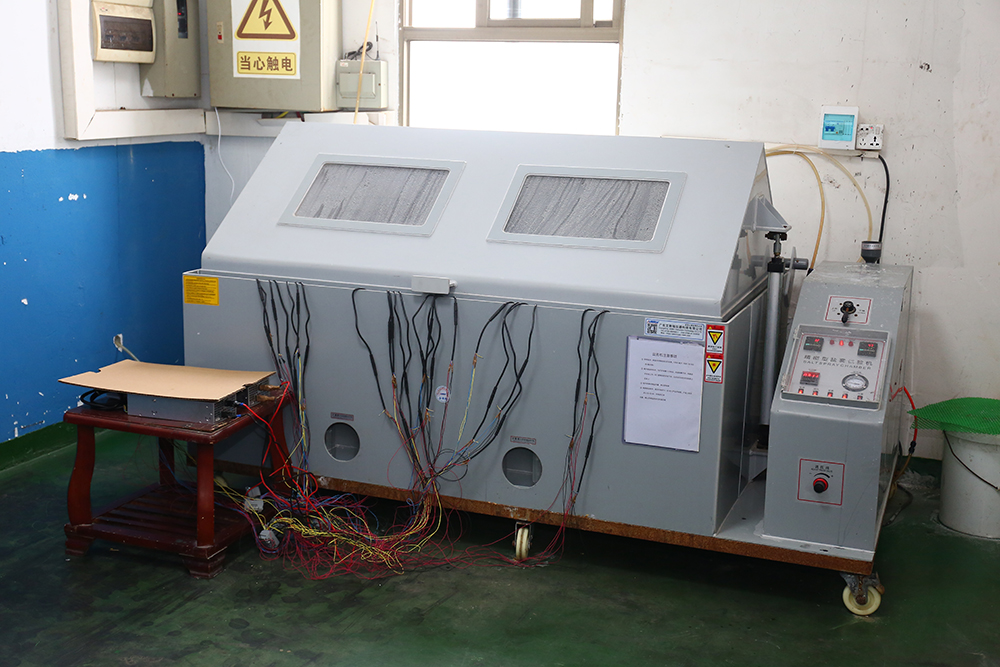
When a precision metal part needs corrosion resistance above 1,000 hours NSS, the buyer should also check how the test is conducted. Substrate type, pre-treatment, edge condition, film thickness and cure condition all influence how many salt spray hours are achieved. A supplier that has its own salt spray tester and documented part-level cases can provide more useful evidence than a supplier that only supplies generic paint data.
Step-by-Step Guide for OEM Buyers
The following sequence can help an OEM buyer evaluate epoxy vs acrylic e-coat during the transition from Evaluation to Execution.
- Define the end-use environment. Identify whether the part is exposed to road salt, humidity, chemicals, UV light, or mechanical abrasion. This determines whether epoxy-rich, acrylic-rich, or an acrylic-epoxy blend is more appropriate.
- Set the required film thickness. Use 15–25 µm as a practical baseline for ordinary precision parts, then confirm the tolerance and whether the supplier can adjust thickness for the part geometry.
- Agree on a corrosion acceptance level. State the required neutral salt spray hours and whether the test is on actual parts or flat panels. Confirm the supplier can provide a part-level test report.
- Check coverage on internal geometry. Ask for evidence that inner cavities, threads, and recessed areas receive coating. The documented Yongxin CNC machining case shows full coverage with no missed coating at corners or inner cavities, which is useful evidence for complex precision parts.
- Confirm color and appearance requirements. If the part must be black only, an epoxy-rich black e-coat is often acceptable. If white, grey, silver, color, or UV-resistant appearance is required, the resin system may need an acrylic component.
- Validate with pre-production parts. Before mass production, request samples using the actual substrate, pre-treatment and film thickness. Because Yongxin supports OEM production, sample confirmation can be followed by larger-volume production rather than a separate laboratory exercise.
- Review commercial and delivery constraints. Yongxin's procurement terms list a minimum order quantity of 100 units, negotiable for large orders, with typical production lead time of 3–45 days depending on quantity. Pre-shipment instrument inspection is part of the acceptance process.
Use Cases: What the Finished Film Must Do
Resin selection should always be tested against a specific use case. The following examples come from Yongxin's documented electrophoretic coating projects and show the kind of performance buyers should expect to qualify.
Electric Motor Manufacturing
For electric motors, the main failure risk is corrosion and rust on housings, frames and internal iron cores. Yongxin's Japanese motor-manufacturer project applied black electrophoretic coating to motor structural components and achieved more than 720 hours of neutral salt spray resistance. The challenge was not simply coating a flat surface; the coating had to cover complex structural gaps uniformly while supporting continuous mass production for large-volume motor orders. The documented result was extended product service life by 5 to 10 years.
CNC Precision Machined Parts
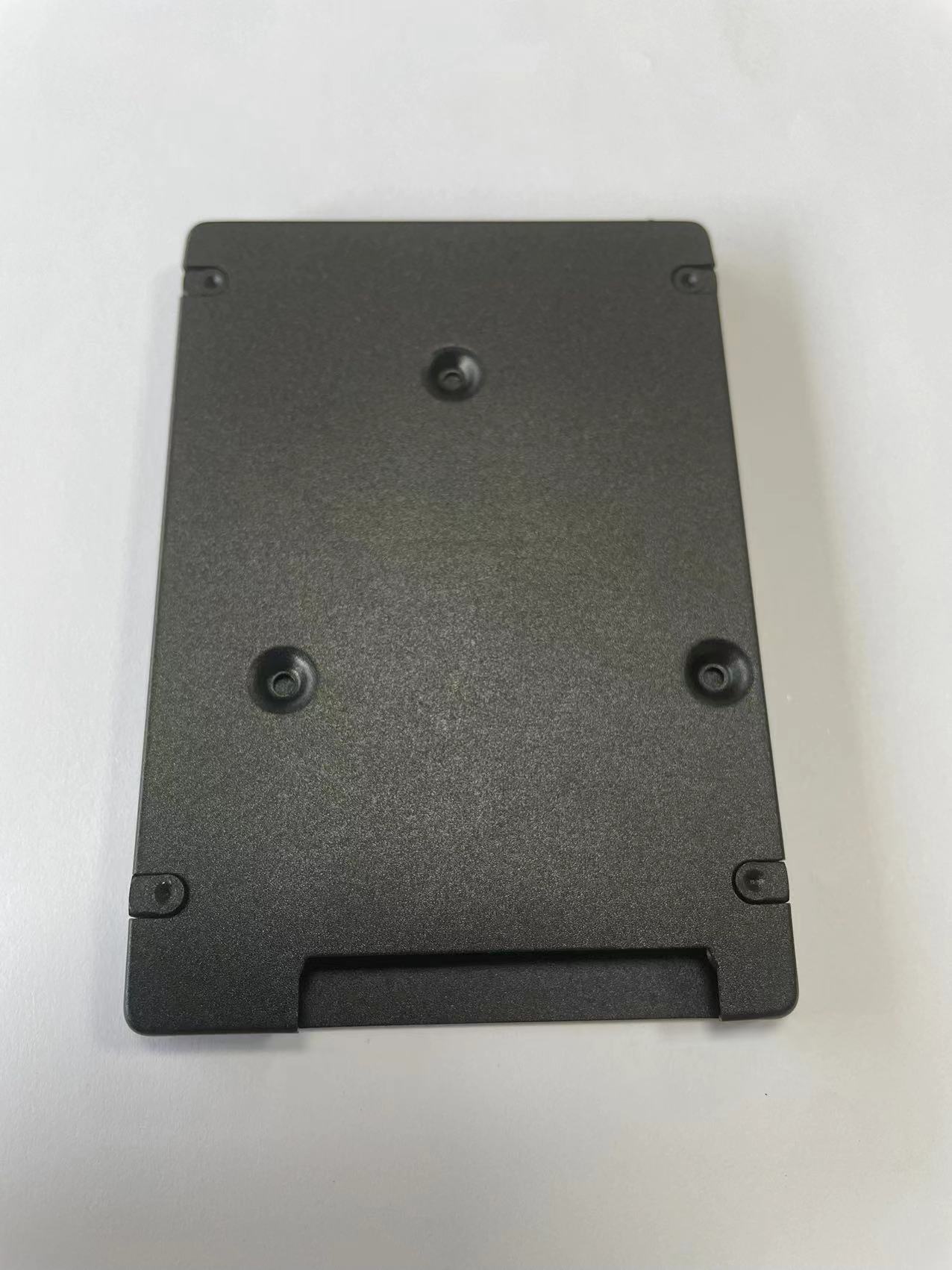
CNC machined parts often have corners, inner cavities, small holes and sharp transitions that are difficult to protect with conventional spray finishing. In a document CNC precision machining case in China, Yongxin's electrophoretic film layer achieved full coverage with no missed coating at corners or inner cavities, strong adhesion, and resistance to acid, alkali, rust and aging. The case also emphasized stable quality through full-process standard operation and flexible customization for multiple materials and colors.
Automotive Components and Fasteners
Although Yongxin does not name a specific automotive project in the source content, the company's published automotive e-coat specification describes a surface treatment used for fasteners, chassis components, body frames, door hinges and engine brackets. That specification calls for more than 1,000 hours of neutral salt spray performance, 95–98% coverage of complex geometries, film thickness consistency within 15–25 microns, and low VOC water-based paint. This is a useful benchmark when comparing epoxy and acrylic e-coat for precision metal parts in the automotive supply chain.
Epoxy vs Acrylic E-Coating: Comparison Table
| Decision driver | Epoxy-dominant e-coat | Acrylic-dominant e-coat | Acrylic-epoxy blend |
|---|---|---|---|
| Primary performance emphasis | Corrosion protection, adhesion and hardness | Color, gloss, flexibility and UV resistance | Balanced hardness, flexibility and corrosion resistance |
| Typical trade-off | May not be the first choice when color stability or UV exposure is the main requirement | May require additional formulation work for maximum salt spray performance | Requires careful formulation to avoid losing the strongest advantages of either resin |
| Common precision part examples | Motor housings, chassis parts, fasteners, castings and stampings in corrosive service | Decorative hardware, white/color parts, consumer products and UV-exposed components | CNC machined parts, mixed-material assemblies and parts needing a practical compromise |
| Parameter | Yongxin black e-coat baseline |
|---|---|
| Resin material options | Black electrophoretic coating product data lists acrylic resin and epoxy resin |
| Film thickness | 15–25 µm for ordinary parts; customizable as needed |
| Corrosion reference | Automotive black e-coat typically passes over 1,000 hours NSS; general typical range is 500–1,500 hours NSS; CASS can exceed 96 hours |
| Coverage | 95–98% coverage of deep cavities, internal holes and complex 3D geometries |
| OEM support | OEM production services, monthly mass production capacity, 100% quality inspection before shipment |
| Commercial baseline | MOQ 100 units, negotiable for large orders; lead time 3–45 days depending on quantity |
How Yongxin Supports OEM Buyers During Evaluation and Execution
Dongguan Yongxin Industrial Co., Ltd. is an electrophoretic coating manufacturer located in Qiaotou Town, Dongguan, China. The company focuses on metal surface treatment and supports OEM buyers with black, white, color, corrosion-resistant and UV-resistant electrophoretic coating services for precision metal parts.
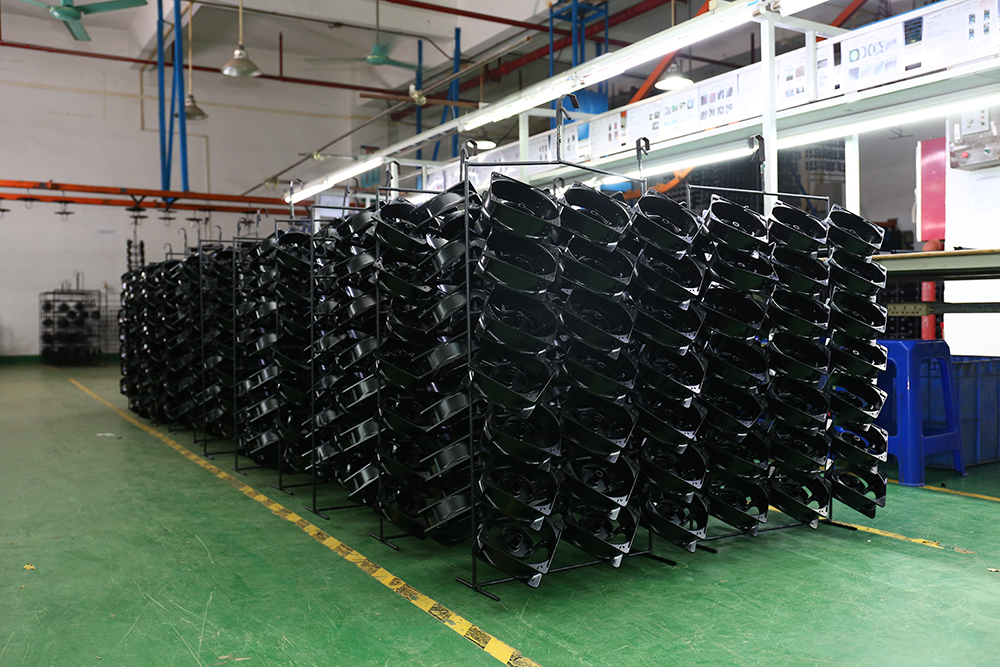
Yongxin operates six professional electrophoresis production lines and has more than 20 general processing machines such as sand blasters, polishers, shot blasting machines and laser equipment. For nearby metal forming and precision machining support, the company also has more than 20 CNC machines, more than 10 die-casting machines and more than 10 metal stamping machines. This allows a buyer to move from casting, stamping or CNC machining into electrophoretic coating without changing the supply chain.
Quality control is supported by an in-house testing system that includes a German FISCHER film thickness gauge, Swiss Zehntner gloss meter, Japanese Konica Minolta spectrophotometer, Japanese Mitutoyo roughness meter, salt spray tester, constant temperature and humidity tester, electron microscope, tape abrasion tester, alcohol rubber friction tester and tank solution analysis equipment. For an OEM buyer comparing epoxy and acrylic e-coat, this level of process control is important because salt spray hours and film appearance can be affected by small changes in pre-treatment, bath parameters or curing conditions.
Choose a System, Then Validate It on Real Parts
For OEM buyers in the Evaluation or Execution stage, the comparison between epoxy and acrylic electrophoretic coating should lead to validation, not paralysis. Begin with the part environment and visual criteria. Select an epoxy-rich or acrylic-rich system only after confirming the supplier can control film thickness, coverage and salt spray performance on the actual geometry.
If the resin chemistry is not specified by the end customer, an acrylic-epoxy blend often offers a sensible starting point for precision metal parts because it balances mechanical robustness and appearance stability. The supplier should be able to explain what will be measured, how the test panels or parts will be prepared, and what thickness will be used.
Yongxin supports OEM production and sample-based validation. For buyers who need a concrete starting point, the company can provide a quote, product samples or technical clarification for black, white, color, epoxy resin and acrylic resin electrophoretic coating requirements.
FAQ
What is the difference between epoxy and acrylic electrophoretic coating?
Epoxy-dominant electrophoretic coating is generally associated with hard, strongly adherent films and high corrosion resistance, which is why it is widely used for automotive and industrial parts requiring high salt spray performance. Acrylic-based electrophoretic coating is more often associated with better color stability, UV resistance and flexibility. Many commercial formulations use acrylic-epoxy combinations to balance these properties. When choosing between them, evaluate the part's service environment, corrosion target, film thickness and appearance requirement rather than relying on the resin name alone.
Can an OEM electrophoretic coating manufacturer with high salt spray performance process precision metal parts?
Yes, if the line is designed for complex geometry and controlled film build. Yongxin's documented precision part processing includes CNC machined parts with full coverage at corners and inner cavities, and electric motor components with neutral salt spray resistance above 720 hours. The company's automotive black e-coat specification also refers to over 1,000 hours of neutral salt spray performance. An OEM buyer should request a part-level salt spray test report, not just a generic coating datasheet.
How thick is the electrophoretic coating on precision metal parts?
Yongxin's standard black electrophoretic coating specification is 15–25 µm for ordinary parts and can be customized as needed. The automotive e-coat specification also references 15–25 microns with controlled thickness variation. Because corrosion and appearance both depend on film thickness, buyers should specify thickness and confirm that the supplier can measure it on actual parts. Yongxin uses a FISCHER film thickness gauge as part of its quality control system.
What commercial and sampling terms apply when choosing Yongxin as an e-coat supplier?
Yongxin provides OEM production services and supports remote after-sales service. The minimum order quantity is 100 units, negotiable for large orders, and typical production lead time is 3–45 days depending on quantity. The acceptance process includes pre-shipment instrument inspection. For a precision metal part project, the most practical next step is to confirm substrate material, target film thickness, color, required neutral salt spray hours and annual quantity before sample production begins.
Next Step for OEM Buyers
Epoxy and acrylic electrophoretic coating are not interchangeable in every application. The right comparison should include resin chemistry, film properties, corrosion testing, part geometry and supplier process control. Yongxin's documented cases and in-house testing capabilities give OEM buyers a stable base for further evaluation.
Need a black e-coat comparison sample or a process assessment for precision metal parts? Contact Mr. Wu at wuzj@yxsydy.com or WhatsApp +8615322922788.
Have Questions or Need More Details?
Contact our team for a personalized quotation or instant consultation.
Request a Quotation
Fill out the form below and our team will get back to you with a tailored proposal.
WhatsApp Direct Chat
Prefer to chat in real-time? Message us on WhatsApp for instant assistance & quick answers.
- Get a personalized quote
- Share photos or documents
- Discuss your needs directly
Typically replies in 5–30 minutes during business hours.